The Athlii Gwaii Blockade and the History of Haida Title
This article was written by Micah Dusseault, and is the product of a collaboration between the HUB Librarian (Anglophone) and students in Professor Jen Gobby's winter 2026 course "TCA425: Organizing for Transformative Change" at the University of Victoria. Many thanks to Micah and Jen for their collaboration on this project.

Introduction
This article examines the Haida Nation's historic and ongoing efforts to assert sovereignty over their territories on Haida Gwaii. It aims to gather insights on Indigenous-led resistance to colonial governance and resource extraction, and into the ways authority is asserted and contested.
The article is divided into two main sections. The first section provides broad historical context, while the second examines the 1985 blockade of Athlii Gwaii (Lyell Island) as a major turning point in the conflict.
Geographical Context
Haida Gwaii, previously referred to by the colonial name the Queen Charlotte Islands, is an archipelago of approximately 150 islands off the northwest coast of British Columbia. The two largest islands, Graham Island and Moresby Island, account for the majority of the 10,000 square km landmass. [1]
The population of Haida Gwaii is approximately 5,000 as of 2025, with most residents concentrated on Graham Island. [2] South Moresby Island is part of the Gwaii Haanas National Park Reserve and Haida Heritage Site, which also includes Athlii Gwaii (Lyell Island).
Haida oral history traces their relationship to the land to the origin of the ocean, extending through the last ice age and the arrival of cedar on the islands. [3] This is supported by archaeological evidence that suggests habitation for over 12,500 years. [4]
Historical Overview
|
c. 10,000 BCE |
Oral histories and archaeological evidence suggests early habitation for over 12,500 years. Haida presence on the land is continuous, with complex social and political systems. |
|
Pre-contact period |
Haida society had a deep political system organized through hereditary leadership and clan systems. Extensive trade networks supported a complex economy. [5] |
|
1774 |
The first recorded colonial contact occurred during Spanish exploration along the northwest coast. [6] At this time, the islands were home to at least 20,000 Haida. [7] |
|
1787 |
George Dixon made the first recorded European landfall on Haida Gwaii and gave the islands the colonial name, “the Queen Charlotte Islands.” [8] |
|
1787 - 1840s |
The maritime fur trade began, and significantly altered the Haida political economy. Trade in sea otter pelts introduces new goods and incentives to the Haida. This ultimately led to the rapid decline of the local sea otter populations, and culminated in massive cultural change for the nation.[9] |
|
1851 - 1853 |
Gold was first discovered on Haida Gwaii, and it officially became a crown colony. [10] |
|
1862 |
The 1862 Pacific Northwest smallpox epidemic devastated the Haida population. By the late 1800s, there were fewer than 600 Haida left on the islands. Populations became increasingly consolidated in Skidegate and Old Masset on Graham Island. [11].jpg) |
|
1885 |
The Canadian government enacted the Indian Act and enforced the ‘potlatch ban’ in an attempt to assimilate Indigenous peoples into settler society. This criminalized central aspects of Haida culture, economy, and political life. [12] |
|
Early to mid 1900s |
Extractivist practices intensified, with little benefit to the local community. Over the course of the century an estimated 105 million cubic metres of raw lumber was removed from the island. This is conducted without the consent of the Haida. [13] |
|
1916 |
In response to the Royal Commission, a colonial government inquiry that reviewed and adjusted reserve boundaries rather than addressing underlying land claims, the Allied Tribes of British Columbia was formed. The coalition challenged federal officials in Ottawa, aiming to limit further encroachments by settler society and secure recognition for Indigenous political and territorial rights. [14] |
|
1927 |
The House of Commons unanimously rejected the Allied Tribes' case for recognition of Aboriginal title, and amended the Indian Act under Section 141 to make it illegal for First Nations to hire lawyers to pursue land claims. The Allied Tribes was subsequently dissolved. [15] |
|
1931 |
Haida and Tsimshian fishermen came together to form the Native Brotherhood of British Columbia, which advocated for Indigenous welfare. [16] [17] The Tsimshian, which means “people inside the Skeena River”, are an Indigenous nation from the mainland's north west coast. [18] |
|
1951 |
Section 141 was repealed, allowing First Nations to once again pursue land claims. [19] |
|
1973 |
The Supreme Court decision Calder et al. V. Attorney-General of British Columbia recognized Aboriginal title as a legal right. [20] |
|
1974 |
The Haida established their own elected government, the Council of the Haida Nation. Following this, the Haida began intensifying legal and political action by initiating land claims and court challenges to contest ongoing logging and assert jurisdiction over their land. [21] |
|
c. 1982 [22] |
The Haida Gwaii Watchmen program began protecting village sites within Gwaii Haanas by maintaining a physical presence. [23] |
|
1985 |
Following unsuccessful legal efforts, the Haida designated Gwaii Haanas a “Haida Heritage Site” and established a blockade on Athlii Gwaii. [24] The blockade lasted three months until logging resumed, but drew significant public attention and marked a turning point for the conflict. [25] |
|
1987 |
The South Moresby Agreement was signed between the Haida Nation and the Government of Canada. This protects Gwaii Haanas from large-scale logging and sets a precedent for future negotiations. [26] |
|
1993 |
The Gwaii Haanas Agreement established a cooperative management framework between the Haida Nation and the Government of Canada over Gwaii Haanas. It entrenches the Haida Nations role as an active steward on the land, but does not settle the underlying title dispute. [27] |
|
2004 |
In Haida Nation v. British Columbia (Minister of Forests), the Supreme Court of Canada affirmed that the Crown has a duty to consult Indigenous peoples when decisions may affect their rights and territories. This was a major legal victory for Indigenous governance. [28] |
|
2005 |
The Haida Nation blockaded two public roads on Graham Island to restrict access to forestry operations. The blockade remains for two months, until it is lifted following a memorandum of understanding with the provincial government. [29] |
|
2009 |
The Kunst’aa guu - Kunst’aayah Reconciliation Protocol established a shared decision-making framework between the Haida Nation and the Government of British Columbia for the management of land and natural resources. [30] |
|
2010 |
The Haida Gwaii Reconciliation Act began implementing parts of this framework in provincial law, formalizing Haida participation in land and natural resource governance. It also replaced the colonial name “the Queen Charlotte Islands” with “Haida Gwaii”. [31] |
|
2018 |
The Gwaii Haanas Gina ‘Waadluxan KilGuhlGa Land-Sea-People Management Plan established a new ten-year framework for managing Gwaii Haanas by integrating land, sea, and cultural stewardship. [32] |
|
2024 |
The Gaayhllxid/Gíihlagalgang “Rising Tide” Haida Title Lands Agreement was reached through negotiation with the provincial government, and formally recognizes Haida title. It sets out the processes for reconciling Haida and provincial jurisdiction and laws. [33] The Haida Nation Recognition Act recognizes Haida governance federally. [34] |
|
2025 |
The British Columbia Supreme Court affirmed Aboriginal title over Haida Gwaii. [35] |
Athlii Gwaii Blockade
Context
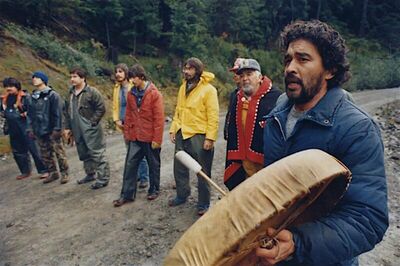
By the early 1970s, industrial logging had expanded significantly across Haida Gwaii, extending into Gwaii Haanas, an area of high cultural and ecological value. [36] In response to poor land management practices associated with this industry, the Haida pursued political lobbying and legal action to halt logging. [37] However, this was met with little engagement from industry-aligned Provincial and Federal governments, and they found no success in the courts. [38]
Dissatisfied with the Canadian government's continued inaction, the Haida warned that continued logging activity would be regarded as an act of aggression. [39] When operations nevertheless continued, Haida community members established a blockade on Athlii Gwaii in October of 1985, [40] declaring: “We are here to protect what we call Haida land from improper logging, [and] poor management.” [41] The blockade is framed not only as an act of environmental action but also as an assertion of Haida jurisdiction over their territory.
Logging companies Western Forest Products and its subcontractor, Frank Bedan Logging Ltd., responded by seeking a court injunction to remove the Haida blockade. This injunction was granted by Justice Harry McKay a week later. [42] Following this ruling, the Haida symbolically stepped aside before returning later that day alongside their elders to re-establish the blockade. [43]
This renewal was quickly met with arrests, and this cycle continued throughout November. Between November 16 and November 29, the RCMP made 72 arrests, drawing increased public attention to the conflict. [44] Protests began at the BC legislature in Victoria in solidarity, and divisions between the provincial and federal governments became visible. [45] Prime Minister Brian Mulroney offered to mediate the dispute, but Premier William Bennett rejected this offer. [46]
After generating national attention, the Haida shifted from a continuous blockade towards a broader political campaign, though logging returned to Athlii Gwaii in January of 1986. [47] In the following March, the ‘Save South Moresby Caraval’ travelled across Canada by rail, accompanied by several Haida elders. [48] It ended in Vancouver with a protest attended by approximately 2,000 people. [49]
At the same time, the federal government continued to pursue resolutions to the conflict. Environmental Minister Tom McMillan publicly stated that the federal government had set aside $106 million to purchase the logging rights to South Moresby in order to establish a protected area. This was again rejected by the provincial government. [50]
The turning point came on May 14th, 1987, when the House of Commons unanimously backed the principle that South Moresby should be protected. [51] In combination with sustained pressure from the Haida Nation, environmental activists, and the federal government, as well as revelations of financial ties between provincial officials and logging interests, this finally led to the provincial government's capitulation. [52] Logging rights were revoked, land was purchased by the federal government, and in July 1987, the South Moresby Memorandum of Understanding was signed.
Power and Politics
The blockade of Athlii Gwaii emerged as an asymmetrical struggle over who held the legitimate right and authority to make decisions regarding Haida Gwaii.
The Haida Nation
The Haida continuously asserted that the land had never been ceded by treaty.
- From this standpoint, the Haida Nation retained governance of the territory and the blockade was simply an exercise of Haida jurisdiction, rather than a protest. [53]
- One Haida participant describes the blockade as a response to “the overall injustices to the Haida Nation, and aboriginal people in general.” [54]
- The blockade was therefore part of the broader struggle for Indigenous rights and sovereignty, not an isolated act of resistance to logging practices.
The Provincial Government
- The Government of British Columbia operated under crown sovereignty, which authorized it to approve industrial activity across the islands.
- This positioned the colonial government as the sole legitimate authority over the land, while Haida assertions of jurisdiction were viewed as unlawful.
- Premier Bill Bennett expressed this view: “What we do not recognize is that they have Indigenous title to over 70% of land in British Columbia. No court has ever said that. No provincial government in the history of British Columbia has ever said that. The land belongs to the people in common in British Columbia.” [55]
The Courts
- The courts were a key mechanism through which provincial authority was exercised.
- Injunctions granted to logging efforts criminalized the Haida's assertions of authority, rendering them legally punishable.
- From this, we can understand the courts not as neutral arbiters, but as institutions that uphold existing power relations.
- Injunctions granted to logging efforts criminalized the Haida's assertions of authority, rendering them legally punishable.
The RCMP
- Enforcement of injunctions is handled by the RCMP, which was deployed to remove Haida community members from the blockade.
- The arrests demonstrate the state's ability to impose its authority through physical force.
- However, the participation of Haida elders complicated this, raising moral questions among the public surrounding the legitimacy of enforcement actions.
- The arrests demonstrate the state's ability to impose its authority through physical force.
The Federal Government
- While not a direct party to the conflict, the federal government became increasingly involved as the blockade drew national attention.
- As public pressure grew, the tensions between the provincial and federal government increased, pushing the province towards negotiation and a resolution.
Haida Tactics
The use of direct action can be understood as a response to unsuccessful efforts to address the issue through colonial legal systems.
“Our fundamental premise had been to exhaust all due process with the province before putting our bodies on the line” - Miles Richardson Jr. [56]
This reflects a shift in their theory of change, in which disruption, visibility, and narrative control became used to generate pressure outside of institutional channels.
Disruption
- The blockade of Athlii Gwaii served as a disruption tactic.
- By physically blocking access to key logging roads, the Haida directly interfered with industrial operations.
- This creates immediate pressure and forces the province to respond.
- It also shifts the conflict away from the courts and onto the land itself, where competing claims to authority could be publicly asserted.
Persistence
- The repeated re-establishment of the blockade reflected a strategy of persistence.
- By continuously returning after enforcement action despite arrests, Haida community members demonstrated a refusal to acknowledge provincial authority as final.
- This made it clear that the conflict could not be resolved solely through legal rulings and physical enforcement.
Nonviolence
- The commitment to nonviolence also reflects a tactic of the Haida.
- By maintaining a peaceful atmosphere, the Haida limited the ability of the state and media to portray land defenders as threats.
- This exposed the coercive nature of enforcement and constrained the state's ability to escalate enforcement without backlash.
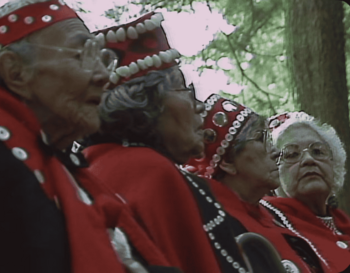
Elder Participation
- The involvement of Haida elders was a significant symbolic and political tactic.
- By having elders present at the blockade, the Haida emphasized the land's cultural, historical, and intergenerational significance.
- This reinforced the blockade as an expression of stewardship and responsibility, rather than merely a protest.
- It also influenced public perception of the conflict, as the arrests of elders drew widespread attention and made the issue more morally charged.
Media
- The use of media was another important tactic in the conflict.
- By engaging with the media through interviews, Haida leaders could share their perspectives directly with the public.
- This helped reduce the impact of outside interpretations and allowed the Haida to more directly influence the narrative surrounding the conflict.
Narratives, Framing, and Legitimacy
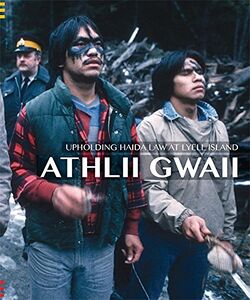
The blockade of Athlii Gwaii was not only a clash over physical land or a competition for jurisdiction, but a fight over how the conflict was to be understood. [57]
The Haida Nation framed the blockade as an assertion of sovereignty, grounded in a responsibility to protect the land from unsustainable practices.
- Their framing emphasized ongoing dispossession, the impacts of colonial governance, and the ongoing relationship between the Haida and the land.
- This perspective viewed the blockade not simply as opposition to logging, but as a broader effort to uphold longstanding governance and stewardship practices.
In contrast, the provincial government and logging companies framed the conflict in terms of legality and economic activity.
- Logging operations were presented as lawfully authorized under provincial jurisdiction, while the blockade was characterized as an obstruction.
- This framing positions the state as the only legitimate authority, and Haida as operating outside established legal processes.
These competing narratives served as mechanisms for reshaping legitimacy. Media coverage, the visibility of arrests, and the linkage of the blockade to broader issues of land and governance allowed the Haida’s efforts to shift how the conflict was understood.
While this did not alter formal legal authority in the short-term, it influenced public perception and created sufficient political pressure for broader long-term transformation. Contributing to broader structural shifts away from the colonial assumption of ownership towards recognition of Aboriginal title. [58] In return, this helped set the stage for legal challenges that ultimately led to the Gaayhllxid/Gíihlagalgang “Rising Tide” Haida Title Lands Agreement in which the provincial government officially recognized Haida title over Haida Gwaii. [59]
References
- ↑ Bristol Foster. “Haida Gwaii.” The Canadian Encyclopedia, 2012. https://thecanadianencyclopedia.ca/en/article/haida-gwaii.
- ↑ Foster. “Haida Gwaii.”
- ↑ Council of the Haida Nation. Haida Land Use Vision. 2005. http://parkscanadahistory.com/publications/gwaiihaanas/hluv-2005.pdf.
- ↑ Parks Canada. “Land, Sea, People.” March 13, 2024. https://parks.canada.ca/pn-np/bc/gwaiihaanas/culture/terre-mer-gens-land-sea-people.
- ↑ American Museum of Natural History. “Haida.” Accessed April 20, 2026. https://www.amnh.org/exhibitions/permanent/northwest-coast/haida.
- ↑ Christon I. Archer. “Juan Josef Pérez Hernández.” The Canadian Encyclopedia, October 24, 2010. https://thecanadianencyclopedia.ca/en/article/juan-josef-perez-hernandez.
- ↑ Parks Canada. “Post-Contact History.” May 3, 2024. https://parks.canada.ca/pn-np/bc/gwaiihaanas/culture/apres-post.
- ↑ BCgenesis. “Haida Gwaii.” Accessed April 20, 2026. https://bcgenesis.uvic.ca/haida_gwaii.html.
- ↑ Parks Canada. “Post-Contact History.” May 3, 2024. https://parks.canada.ca/pn-np/bc/gwaiihaanas/culture/apres-post.
- ↑ Legislative Assembly of British Columbia. “1853 - The Colony of Queen Charlotte Islands.” Accessed April 20, 2026. https://www.leg.bc.ca/learn/discover-your-legislature/1853-colony-queen-charlotte-islands.
- ↑ Parks Canada. “Post-Contact History.” May 3, 2024. https://parks.canada.ca/pn-np/bc/gwaiihaanas/culture/apres-post.
- ↑ Kinship Rising. “Haida Gwaii | Yahgu ‘laanaas Pole Raising.” Accessed April 20, 2026. https://onlineacademiccommunity.uvic.ca/kinshiprising/haidagwaii/.
- ↑ Takeda, Louise. Islands’ Spirit Rising. University of British Columbia Press, 2014. p.68. https://doi.org/10.59962/9780774827676.
- ↑ Ibid., p. 37.
- ↑ Ibid.
- ↑ The Native Brotherhood of British Columbia. “About Us.” Accessed April 20, 2026. https://nativebrotherhood.ca/sample-page/.
- ↑ The Native Brotherhood of British Columbia. “About Us.” Accessed April 20, 2026. https://nativebrotherhood.ca/sample-page/.
- ↑ American Museum of Natural History. Trimshian. n.d. Accessed April 20, 2026. https://www.amnh.org/exhibitions/permanent/northwest-coast/tsimshian.
- ↑ Amy Swiffen. “When Canada Banned Indigenous People from Seeking Justice.” The Tyee, October 21, 2022. https://thetyee.ca/Analysis/2022/10/21/When-Canada-Banned-Indigenous-People-Seeking-Justice/.
- ↑ Crown-Indigenous Relations and Northern Affairs Canada. “Modern Treaties.” February 17, 2026. https://www.rcaanc-cirnac.gc.ca/eng/1677073191939/1677073214344.
- ↑ Haida Nation. “Council of the Haida Nation.” Accessed April 20, 2026. https://www.haidanation.ca/about/chn.
- ↑ The creation year of the Watchmen program is unclear, with Haida sources suggesting between 1981-1985.
- ↑ Haida Nation, “Council of the Haida Nation.” Accessed April 20, 2026. https://www.haidanation.ca/about/chn.
- ↑ Parks Canada. “History of Establishment.” May 3, 2024. https://parks.canada.ca/pn-np/bc/gwaiihaanas/info/histoire-history.
- ↑ Haida Nation. “Press Release from the Council of the Haida Nation – Court Declaration of Haida Title.” September 5, 2025. https://www.haidanation.ca/public-notices/press-release-from-the-council-of-the-haida-nation-court-declaration-of-haida-titlenbsp?
- ↑ Parks Canada. “History of Establishment.” May 3, 2024. https://parks.canada.ca/pn-np/bc/gwaiihaanas/info/histoire-history.
- ↑ Parks Canada. “History of Establishment.” May 3, 2024. https://parks.canada.ca/pn-np/bc/gwaiihaanas/info/histoire-history.
- ↑ Haida Nation v. British Columbia (Minister of Forests) (2004). https://decisions.scc-csc.ca/scc-csc/scc-csc/en/item/2189/index.do.
- ↑ Pierce Lefebvre Consulting. Socio-Economic Assessment of Haida Gwaii / Queen Charlotte Islands Land Use Viewpoints. 2006. https://www2.gov.bc.ca/assets/gov/farming-natural-resources-and-industry/natural-resource-use/land-water-use/crown-land/land-use-plans-and-objectives/westcoast-region/haidagwaii-slua/socio_economic_assesstment_land_use_viewpoints.pdf.
- ↑ Haida Nation, and British Columbia. Kunst’aa Guu – Kunst’aayah Reconciliation Protocol. 2009. https://static1.squarespace.com/static/66a42eb6e157224ea438eb79/t/68504551e192b41f29f1bad3/1750091091453/Kunstaa-guu_Kunstaayah_Agreement.pdf.
- ↑ Haida Gwaii Reconciliation Act (2010). https://www.bclaws.gov.bc.ca/civix/document/id/complete/statreg/10017_01.
- ↑ Parks Canada. “Gina ‘Waadluxan KilGuhlGa Land-Sea-People Management Plan.” May 3, 2025. https://parks.canada.ca/pn-np/bc/gwaiihaanas/info/plan.
- ↑ Haida Nation, and British Columbia. GAAYHLLXID GÍIHLAGALGANG • “RISING TIDE” Haida Title Lands Agreement. 2024. https://www2.gov.bc.ca/assets/gov/environment/natural-resource-stewardship/consulting-with-first-nations/agreements/final_gaayhllxid_giihlagalgang_rising_tide_haida_title_lands_agreement.pdf.
- ↑ Canada. Haida Nation Recognition Act, S.C. 2024, c. 29. https://laws.justice.gc.ca/eng/acts/H-0.3/page-1.html
- ↑ British Columbia. “Provincial Agreement on Haida Aboriginal Title.” February 19, 2025. https://www2.gov.bc.ca/gov/content/environment/natural-resource-stewardship/consulting-with-first-nations/first-nations-negotiations/first-nations-a-z-listing/haida-nation-council-of/haida-title-agreement.
- ↑ Louise Takeda, and Røpke Inge. “Power and Contestation in Collaborative Ecosystem-Based Management: The Case of Haida Gwaii.” Ecological Economics 70, no. 2 (December 2010): 178–88. https://doi.org/10.1016/J.ECOLECON.2010.02.007.
- ↑ Suzanne von der Porten. “Lyell Island (Athlii Gwaii) Case Study: Social Innovation by the Haida Nation.” American Indian Culture and Research Journal 38, no. 3 (January 2014): 85–106. https://doi.org/10.17953/AICR.38.3.E15186340020J837.
- ↑ Mia Wieler. “Holding the Line at Athlii Gwaii: An Assertion of Haida Sovereignty.” On Politics 18, no. 1 (2025): 1–13. https://journals.uvic.ca/index.php/onpolitics/issue/view/1625.
- ↑ Christopher Auchter. The Stand. National Film Board of Canada, 2024. https://www.nfb.ca/film/the-stand/.
- ↑ Wieler, “Holding the Line."
- ↑ Auchter, The Stand.
- ↑ Benjamin Isitt. “Standoffs at Meares and Lyell Islands: Protest, Injunctions, and the Indigenous Land Question in British Columbia, 1984–5.” In Canadian State Trials, Volume V: World War, Cold War, and Challenges to Sovereignty, 1939-1990, 380–427. 2022. https://www-jstor-org.ezproxy.library.uvic.ca/stable/10.3138/j.ctv31nzk4b.16?seq=1.
- ↑ Ibid.
- ↑ Auchter, The Stand.
- ↑ Takeda, Islands’ Spirit Rising.
- ↑ Auchter, The Stand.
- ↑ Isitt, “Standoffs at Meares and Lyell Islands."
- ↑ Jennifer Iredale, and Ursula Pfahler. Community Involvement in the Nomination and Management of SGang Gwaay World Heritage Site. n.d. https://www2.gov.bc.ca/assets/gov/british-columbians-our-governments/our-history/historic-places/documents/heritage/sgang_gwaay_case_study.pdf.
- ↑ Wieler, “Holding the Line."
- ↑ Auchter, The Stand.
- ↑ Suzanne Lesli Elizabeth Hawkes. “Co-Management and Protected Areas in Canada: The Case of Gwaii Haanas.” 1995. https://summit.sfu.ca/_flysystem/fedora/2024-10/Hawkes1995.pdf.
- ↑ Auchter, The Stand.
- ↑ Wieler, "Holding the Line."
- ↑ Auchter, The Stand.
- ↑ Auchter, The Stand.
- ↑ Wieler, "Holding the Line."
- ↑ Wieler, "Holding the Line."
- ↑ Takeda and Inge, "Power and Contestation."
- ↑ Wieler, "Holding the Line."