How Victoria College Divested from Fossil Fuels: Difference between revisions
| (One intermediate revision by the same user not shown) | |||
| Line 2: | Line 2: | ||
= Introduction = | = Introduction = | ||
<p>This article discusses '''Divest Vic''', the campaign for fossil fuel divestment at Victoria College, a federated college at the University of Toronto (UofT).<ref>Olivia Chen, "The Explainer: Federated colleges," ''The Varsity'', September 19, 2016. https://thevarsity.ca/2016/09/19/the-explainer-federated-colleges/</ref> The timeline for this campaign begins during the UofT divestment campaign, starting from Fall of 2018. Following several years of campaigning, activists engaged in an 18-day occupation of the Victoria College building (also referred to as Old Vic).<ref>Abdul Martin Sarfraz, " ‘We will not leave’: University students dig in heels at fossil fuel divestment protest ," ''National Observer'', April 11, 2023. https://www.nationalobserver.com/2023/04/11/news/we-will-not-leave-university-students-dig-heels-fossil-fuel-divestment-protest</ref> The announcement by the university administration to commit to divestment was made on April 13, 2023, after which students left the building.</p><ref>Jessie Schwalb, "Victoria University agrees to divest from fossil fuel companies by 2030," ''The Varsity'', April 13, 2023. https://thevarsity.ca/2023/04/13/victoria-university-agrees-to-divest-from-fossil-fuel-companies-by-2030/ </ref> | <p>This article discusses '''Divest Vic''', the campaign for fossil fuel divestment at Victoria College, a federated college at the University of Toronto (UofT). <ref>Olivia Chen, "The Explainer: Federated colleges," ''The Varsity'', September 19, 2016. https://thevarsity.ca/2016/09/19/the-explainer-federated-colleges/</ref> The timeline for this campaign begins during the UofT divestment campaign, starting from Fall of 2018. Following several years of campaigning, activists engaged in an 18-day occupation of the Victoria College building (also referred to as Old Vic). <ref>Abdul Martin Sarfraz, " ‘We will not leave’: University students dig in heels at fossil fuel divestment protest ," ''National Observer'', April 11, 2023. https://www.nationalobserver.com/2023/04/11/news/we-will-not-leave-university-students-dig-heels-fossil-fuel-divestment-protest</ref> The announcement by the university administration to commit to divestment was made on April 13, 2023, after which students left the building.</p> | ||
[[File:All eyes on vic.jpg|600px|thumb]] | <ref>Jessie Schwalb, "Victoria University agrees to divest from fossil fuel companies by 2030," ''The Varsity'', April 13, 2023. https://thevarsity.ca/2023/04/13/victoria-university-agrees-to-divest-from-fossil-fuel-companies-by-2030/ </ref> [[File:All eyes on vic.jpg|600px|thumb|Banner at the Climate Justice UofT occupation of the Old Vic building.]] | ||
<p>This case study explores:</p> | <p>This case study explores:</p> | ||
*Policy windows and points of entry within university institutions | *Policy windows and points of entry within university institutions | ||
| Line 22: | Line 22: | ||
= Background: Divestment at UofT = | = Background: Divestment at UofT = | ||
<p>[https://en.wiki.lehub.ca/index.php/Divestment Divestment] from fossil fuels is one of several strategies used by the climate justice movement to advance its goals. These campaigns became widespread across university campuses in the 2010s.</p> | <p>[https://en.wiki.lehub.ca/index.php/Divestment Divestment] from fossil fuels is one of several strategies used by the climate justice movement to advance its goals. These campaigns became widespread across university campuses in the 2010s.</p> | ||
<p>At the University of Toronto, the campaign for fossil fuel divestment lasted over a decade. It began with the formation of Toronto350 and its campus branch UofT350 in June 2012, with a “re-launch” of the campaign occurring after the formation of LeapUofT in the fall of 2016. LeapUofT was formed a few months after Meric Gertler, the UofT president at the time, rejected fossil fuel divestment, against the recommendation of his advisory committee. Leap began supporting divestment campaigns of the university’s federated colleges, including Victoria College. | <p>At the University of Toronto, the campaign for fossil fuel divestment lasted over a decade. It began with the formation of Toronto350 and its campus branch UofT350 in June 2012, with a “re-launch” of the campaign occurring after the formation of LeapUofT in the fall of 2016. LeapUofT was formed a few months after Meric Gertler, the UofT president at the time, rejected fossil fuel divestment, against the recommendation of his advisory committee. Leap began supporting divestment campaigns of the university’s federated colleges, including Victoria College.<ref>Amanda Harvey-Sánchez, ''U of T Fossil Fuel Divestment Timeline'', 2022. https://utoronto.scholaris.ca/server/api/core/bitstreams/d57aea4f-3485-4c94-8533-45c2e128b011/content</ref></p> | ||
<p>After almost a decade of student activism, Gertler announced the decision to divest the UofT endowment on October 27, 2021.<ref>Meric S. Gertler, "Letter to the Community: Divestment, Net Zero and a Climate Positive Campus," ''Office of the President''. https://president.utoronto.ca/letter-to-the-community-divestment-net-zero-and-a-climate-positive-campus/</ref> A comprehensive summary of the University of Toronto campaign, as well as insights about the movement and the divestment decision, can be found in [https://utoronto.scholaris.ca/server/api/core/bitstreams/d57aea4f-3485-4c94-8533-45c2e128b011/content this working paper] by Amanda Harvey-Sánchez, [https://briarpatchmagazine.com/articles/view/divestment-and-beyond this article] by Harvey-Sánchez and Sydney Lang, and through the [https://climatejusticeto.com/radio/ Divestment Generation podcast miniseries].</p> | <p>After almost a decade of student activism, Gertler announced the decision to divest the UofT endowment on October 27, 2021. <ref>Meric S. Gertler, "Letter to the Community: Divestment, Net Zero and a Climate Positive Campus," ''Office of the President''. https://president.utoronto.ca/letter-to-the-community-divestment-net-zero-and-a-climate-positive-campus/</ref> A comprehensive summary of the University of Toronto campaign, as well as insights about the movement and the divestment decision, can be found in [https://utoronto.scholaris.ca/server/api/core/bitstreams/d57aea4f-3485-4c94-8533-45c2e128b011/content this working paper] by Amanda Harvey-Sánchez, [https://briarpatchmagazine.com/articles/view/divestment-and-beyond this article] by Harvey-Sánchez and Sydney Lang, and through the [https://climatejusticeto.com/radio/ Divestment Generation podcast miniseries].</p> | ||
<p>UofT’s commitment to divest did not apply to the federated colleges. UofT has 7 undergraduate colleges, 3 of which (Victoria, Trinity, and St. Michael’s) are federated. These colleges have their own administration and are governed separately from the larger university. '''They are technically separate universities, have their own endowments, and are financially independent. As a result, these colleges needed to make their own, [https://docs.google.com/document/d/1-uMH4WN6_695Qp5rraDbC5_KnSDrEexnLdLCNiwg6Pw/edit?tab=t.0 separate commitments to divestment]'''.</p> | <p>UofT’s commitment to divest did not apply to the federated colleges. UofT has 7 undergraduate colleges, 3 of which (Victoria, Trinity, and St. Michael’s) are federated. These colleges have their own administration and are governed separately from the larger university. '''They are technically separate universities, have their own endowments, and are financially independent. As a result, these colleges needed to make their own, [https://docs.google.com/document/d/1-uMH4WN6_695Qp5rraDbC5_KnSDrEexnLdLCNiwg6Pw/edit?tab=t.0 separate commitments to divestment]'''.</p> | ||
<p>Within a year of Gertler’s divestment announcement, the campaign to push for divestment at Victoria College became a focus. Vic had between $6 to $9 million in indirect investments in fossil fuels, about 3.5% of the college’s endowment.<ref>Rhonda McEwen, "Letter to the Community," ''Victoria College'', April 6, 2023. https://vic.utoronto.ca/news/letter-to-the-community</ref> Additionally, Vic owned an active oil well in Saskatchewan, bequeathed by an alum.<ref>"Mary Mounfield," ''Chancellors' Circle of Benefactors'', n.d. https://www.chancellorscircle.utoronto.ca/members/mary-mounfield/</ref></p> | <p>Within a year of Gertler’s divestment announcement, the campaign to push for divestment at Victoria College became a focus. Vic had between $6 to $9 million in indirect investments in fossil fuels, about 3.5% of the college’s endowment. <ref>Rhonda McEwen, "Letter to the Community," ''Victoria College'', April 6, 2023. https://vic.utoronto.ca/news/letter-to-the-community</ref> Additionally, Vic owned an active oil well in Saskatchewan, bequeathed by an alum. <ref>"Mary Mounfield," ''Chancellors' Circle of Benefactors'', n.d. https://www.chancellorscircle.utoronto.ca/members/mary-mounfield/</ref> </p> | ||
== Impact of the UofT campaign on Divest Vic == | == Impact of the UofT campaign on Divest Vic == | ||
The 11-year long campaign targeting UofT set the stage for Divest Vic. The UofT movement increased students’ understanding about the climate crisis and generated support for divestment on campus. According to a Divest Vic organizer, this “set up leverage for our claims to get the federated colleges to divest.” Years of campaigning made divestment a reasonable demand, and UofT’s eventual commitment to divest its endowment<ref>It is unclear what exactly led to the decision to divest UofT’s endowment, and people involved with both campaigns attribute the decision to a variety of external factors. However, it is difficult to argue that the efforts of students pushing for divestment for 11 years had no impact; likely, these made divestment a reputation booster for UofT. This interpretation is consistent with the fact that the months preceding divestment had involved several events impacting UofT’s image, which campaign participants suggested were mitigated by the positive press of the divestment announcement.</ref> entrenched it as an important step towards addressing climate change on campus, thus making it hard for the federated colleges to outright reject. This leverage allowed activists to engage in more severe and disruptive actions. | The 11-year long campaign targeting UofT set the stage for Divest Vic. The UofT movement increased students’ understanding about the climate crisis and generated support for divestment on campus. According to a Divest Vic organizer, this “set up leverage for our claims to get the federated colleges to divest.” Years of campaigning made divestment a reasonable demand, and UofT’s eventual commitment to divest its endowment <ref>It is unclear what exactly led to the decision to divest UofT’s endowment, and people involved with both campaigns attribute the decision to a variety of external factors. However, it is difficult to argue that the efforts of students pushing for divestment for 11 years had no impact; likely, these made divestment a reputation booster for UofT. This interpretation is consistent with the fact that the months preceding divestment had involved several events impacting UofT’s image, which campaign participants suggested were mitigated by the positive press of the divestment announcement.</ref> entrenched it as an important step towards addressing climate change on campus, thus making it hard for the federated colleges to outright reject. This leverage allowed activists to engage in more severe and disruptive actions. | ||
<p>The UofT campaign’s results and the experiences of its members also provided valuable knowledge and resources for Divest Vic organizers.<ref>Anonymous interview 2.</ref></p> | <p>The UofT campaign’s results and the experiences of its members also provided valuable knowledge and resources for Divest Vic organizers. <ref>Anonymous interview 2.</ref> </p> | ||
*UofT campaign participants interviewed for Climate Justice Radio’s Divestment Generation miniseries discussed facing “delays and secrecy” from the university.<ref>"Divest Generation Mini Series: Episode 1," 23:00 minutes, ''Climate Justice Radio''. https://climatejusticeto.com/radio/</ref> | *UofT campaign participants interviewed for Climate Justice Radio’s Divestment Generation miniseries discussed facing “delays and secrecy” from the university. <ref>"Divest Generation Mini Series: Episode 1," 23:00 minutes, ''Climate Justice Radio''. https://climatejusticeto.com/radio/</ref> | ||
*Lang and Harvey-Sánchez state in their 2022 article: “The university benefited from the way we “civilly” and “rationally” played the inside game, and the university’s rejection of divestment in 2016 reveals the risks and consequences of such an approach.”<ref>Lang and Harvey-Sánchez, "Divestment and beyond," ''Briarpatch'', May 4, 2022. https://briarpatchmagazine.com/articles/view/divestment-and-beyond</ref> | *Lang and Harvey-Sánchez state in their 2022 article: “The university benefited from the way we “civilly” and “rationally” played the inside game, and the university’s rejection of divestment in 2016 reveals the risks and consequences of such an approach.” <ref>Lang and Harvey-Sánchez, "Divestment and beyond," ''Briarpatch'', May 4, 2022. https://briarpatchmagazine.com/articles/view/divestment-and-beyond</ref> | ||
*The UofT campaign revealed that the university was concerned about a possible sit-in.<ref>Facebook post from UofT 350.org. https://www.facebook.com/share/1AuGwj3SBy/</ref> | *The UofT campaign revealed that the university was concerned about a possible sit-in. <ref>Facebook post from UofT 350.org. https://www.facebook.com/share/1AuGwj3SBy/</ref> | ||
= Actors = | = Actors = | ||
| Line 45: | Line 45: | ||
'''VUSAC Sustainability Commission''' | '''VUSAC Sustainability Commission''' | ||
| style="width: 80.3024%; height: 23px;" | | | style="width: 80.3024%; height: 23px;" | | ||
A group within the Victoria University Students’ Administrative Council (VUSAC), Vic’s student government. Responsible for promoting climate justice initiatives and sustainable practices and policies at Vic.<ref>''Victoria University Students' Administrative Council Constitution'', revised March 2025. https://docs.google.com/document/d/1-R4ZLKRdQ_Q3Z-5x_qU1VkIx5YSkpyz76dyq3-E-Ju0/edit?tab=t.0 </ref>. | A group within the Victoria University Students’ Administrative Council (VUSAC), Vic’s student government. Responsible for promoting climate justice initiatives and sustainable practices and policies at Vic. <ref>''Victoria University Students' Administrative Council Constitution'', revised March 2025. https://docs.google.com/document/d/1-R4ZLKRdQ_Q3Z-5x_qU1VkIx5YSkpyz76dyq3-E-Ju0/edit?tab=t.0 </ref> . | ||
|- style="height: 23px;" | |- style="height: 23px;" | ||
| style="width: 19.6976%; height: 23px; background-color: #99e1d9;" | | | style="width: 19.6976%; height: 23px; background-color: #99e1d9;" | | ||
| Line 53: | Line 53: | ||
*4 students are elected to the BoR, and the President of VUSAC holds an ex-officio position | *4 students are elected to the BoR, and the President of VUSAC holds an ex-officio position | ||
*There are 4 committees within the BoR. Relevant to divestment are the Property Committee and the Investment Committee. | *There are 4 committees within the BoR. Relevant to divestment are the Property Committee and the Investment Committee. | ||
*At least one student sits on each Committee, except for the Investment Committee, as per the Committees’ Mandates.<ref>"Board of Regents," ''Victoria College''. https://vicu.utoronto.ca/about-victoria/board-of-regents</ref> | *At least one student sits on each Committee, except for the Investment Committee, as per the Committees’ Mandates. <ref>"Board of Regents," ''Victoria College''. https://vicu.utoronto.ca/about-victoria/board-of-regents</ref> | ||
|- style="height: 23px;" | |- style="height: 23px;" | ||
| style="width: 19.6976%; height: 23px; background-color: #99e1d9;" | | | style="width: 19.6976%; height: 23px; background-color: #99e1d9;" | | ||
'''President Rhonda McEwen''' | '''President Rhonda McEwen''' | ||
| style="width: 80.3024%; height: 23px;" | | | style="width: 80.3024%; height: 23px;" | | ||
Current President of Victoria University (as of January 2026), whose term began in July 2022. McEwen being new to her role was considered beneficial to the campaign. Organizers understood that an encampment during her first year and her handling of it would reflect on her leadership. They hoped to direct her towards taking a “climate leader” role and making decisions accelerating divestment, especially because she publicly expressed support for the idea.<ref>Max Lees, "An interview with Vic President Dr. Rhonda McEwen," ''The Strant'', October 11, 2022. https://thestrand.ca/an-interview-with-vic-president-dr-rhonda-mcewen/</ref> | Current President of Victoria University (as of January 2026), whose term began in July 2022. McEwen being new to her role was considered beneficial to the campaign. Organizers understood that an encampment during her first year and her handling of it would reflect on her leadership. They hoped to direct her towards taking a “climate leader” role and making decisions accelerating divestment, especially because she publicly expressed support for the idea. <ref>Max Lees, "An interview with Vic President Dr. Rhonda McEwen," ''The Strant'', October 11, 2022. https://thestrand.ca/an-interview-with-vic-president-dr-rhonda-mcewen/</ref> | ||
|- style="height: 23px;" | |- style="height: 23px;" | ||
| style="width: 19.6976%; height: 23px; background-color: #99e1d9;" | | | style="width: 19.6976%; height: 23px; background-color: #99e1d9;" | | ||
'''Victoria and UofT community''' | '''Victoria and UofT community''' | ||
| style="width: 80.3024%; height: 23px;" | | | style="width: 80.3024%; height: 23px;" | | ||
Includes individual students, faculty, and staff. Also refers to student groups that participated in the campaign and occupation,<ref>Climate Justice UofT, ''All Eyes on Vic: Welcome to the Occupation of Old Vic''. https://docs.google.com/document/d/16ynLn3Jp3E2B0wZKJiiO_Zu_RrxE2p5n9FUbz_NPOmw/edit?tab=t.0</ref> such as: | Includes individual students, faculty, and staff. Also refers to student groups that participated in the campaign and occupation, <ref>Climate Justice UofT, ''All Eyes on Vic: Welcome to the Occupation of Old Vic''. https://docs.google.com/document/d/16ynLn3Jp3E2B0wZKJiiO_Zu_RrxE2p5n9FUbz_NPOmw/edit?tab=t.0</ref> such as: | ||
*Banking on a Better Future | *Banking on a Better Future | ||
*PEARS Project | *PEARS Project | ||
| Line 81: | Line 81: | ||
| style="width: 80.3024%; height: 23px;" | | | style="width: 80.3024%; height: 23px;" | | ||
LeapUofT begins building support for fossil fuel divestment at Victoria College through various actions, including: | LeapUofT begins building support for fossil fuel divestment at Victoria College through various actions, including: | ||
*A sidewalk chalk party outside Goldring Student Centre on October 11, which was planned to coincide with a BoR meeting. According to an internal document: “organizers collected divestment petition signatures, distributed flyers and buttons, and talked to passersby about the campaign.”<ref>Climate Justice UofT, ''Put Climate Justice on the Agenda! Sidewalk Chalk Party'', Facebook event, October 11, 2018. https://www.facebook.com/events/2134519083488449</ref> | *A sidewalk chalk party outside Goldring Student Centre on October 11, which was planned to coincide with a BoR meeting. According to an internal document: “organizers collected divestment petition signatures, distributed flyers and buttons, and talked to passersby about the campaign.” <ref>Climate Justice UofT, ''Put Climate Justice on the Agenda! Sidewalk Chalk Party'', Facebook event, October 11, 2018. https://www.facebook.com/events/2134519083488449</ref> | ||
*A “Carbon Birthmark” free tattoo event, on December 13, held at the Cat’s Eye Student Lounge at Victoria College, in order to increase awareness and support for divestment among students.<ref>Climate Justice UofT, ''Stick it to the Board of Regents'', Facebook event, December 13, 2018. https://www.facebook.com/events/270701486937879</ref> | *A “Carbon Birthmark” free tattoo event, on December 13, held at the Cat’s Eye Student Lounge at Victoria College, in order to increase awareness and support for divestment among students. <ref>Climate Justice UofT, ''Stick it to the Board of Regents'', Facebook event, December 13, 2018. https://www.facebook.com/events/270701486937879</ref> | ||
Students engage with the Victoria College administration through email throughout December. | Students engage with the Victoria College administration through email throughout December. | ||
| Line 103: | Line 103: | ||
'''Fall 2020''' | '''Fall 2020''' | ||
| style="width: 80.3024%; height: 23px;" | | | style="width: 80.3024%; height: 23px;" | | ||
LeapUofT collaborates with VUSAC to put out a statement in support of the Divest Canada Coalition open letter.<ref>Victoria University Students' Administrative Council, ''Divest Canada Coalition Open Letter'', October 2, 2020. https://www.vusac.ca/_files/ugd/7ea68e_75e34c320dda496fb928f2f840a12a51.pdf</ref> | LeapUofT collaborates with VUSAC to put out a statement in support of the Divest Canada Coalition open letter. <ref>Victoria University Students' Administrative Council, ''Divest Canada Coalition Open Letter'', October 2, 2020. https://www.vusac.ca/_files/ugd/7ea68e_75e34c320dda496fb928f2f840a12a51.pdf</ref> | ||
|- style="height: 23px;" | |- style="height: 23px;" | ||
| Line 109: | Line 109: | ||
'''Winter 2021''' | '''Winter 2021''' | ||
| style="width: 80.3024%; height: 23px;" | | | style="width: 80.3024%; height: 23px;" | | ||
2 members of the fossil fuel campaign are elected to the BoR as student representatives (with voting privileges) during the VUSAC elections in March.<ref>Mathula Muhundan, "VUSAC Fall 2021 elections results," ''The Strand'', October 13, 2021. https://thestrand.ca/vusac-fall-2021-elections-results/</ref> | 2 members of the fossil fuel campaign are elected to the BoR as student representatives (with voting privileges) during the VUSAC elections in March. <ref>Mathula Muhundan, "VUSAC Fall 2021 elections results," ''The Strand'', October 13, 2021. https://thestrand.ca/vusac-fall-2021-elections-results/</ref> | ||
|- style="height: 23px;" | |- style="height: 23px;" | ||
| Line 123: | Line 123: | ||
Student BoR members discuss divestment at several BoR meetings and during individual check-ins with BoR Chair Cynthia Crysler. | Student BoR members discuss divestment at several BoR meetings and during individual check-ins with BoR Chair Cynthia Crysler. | ||
The BoR commits to producing reports from their Property Committee and Investment Committee “advising whether Victoria College should divest.” These are set to be published by February 2023.<ref>Climate Justice UofT, ''All Eyes on Vic''.</ref> | The BoR commits to producing reports from their Property Committee and Investment Committee “advising whether Victoria College should divest.” These are set to be published by February 2023. <ref>Climate Justice UofT, ''All Eyes on Vic''.</ref> | ||
|- style="height: 23px;" | |- style="height: 23px;" | ||
| Line 129: | Line 129: | ||
'''Winter 2022''' | '''Winter 2022''' | ||
| style="width: 80.3024%; height: 23px;" | | | style="width: 80.3024%; height: 23px;" | | ||
Organizers create a petition to Vic students calling for divestment and circulate it by reaching out to individuals and student organizations/clubs.<ref>Climate Justice UofT, ''Divest Vic! Petition''. https://docs.google.com/forms/d/e/1FAIpQLSfPo_w781_BQmViGYRLIp7gI4V36PmYU_CrSHC-SvKlpSd0xw/viewform</ref> | Organizers create a petition to Vic students calling for divestment and circulate it by reaching out to individuals and student organizations/clubs. <ref>Climate Justice UofT, ''Divest Vic! Petition''. https://docs.google.com/forms/d/e/1FAIpQLSfPo_w781_BQmViGYRLIp7gI4V36PmYU_CrSHC-SvKlpSd0xw/viewform</ref> | ||
In January and February, a student on the BoR attempts to bring a motion to divest at an upcoming Board meeting and is informed that this motion needs to be brought through the Committees. | In January and February, a student on the BoR attempts to bring a motion to divest at an upcoming Board meeting and is informed that this motion needs to be brought through the Committees. | ||
| Line 146: | Line 146: | ||
*Banks off campus | *Banks off campus | ||
*Fossil free research | *Fossil free research | ||
Rhonda McEwen takes office as President of Victoria College in July. As reported by McEwen at a VUSAC Caucus meeting in March 2023, she receives a “Presidential Report” discussing divestment and “comparing and contrasting” Vic’s situation with UofT’s.<ref>Victoria University Students' Administrative Council, "Draft: 030323 Winter Caucus Minutes," March 3, 2023. https://docs.google.com/document/d/12tOBckqXKe5eaK8j344jd1czJhgdhHoMlcqADlVCKBc/edit?tab=t.0</ref> | Rhonda McEwen takes office as President of Victoria College in July. As reported by McEwen at a VUSAC Caucus meeting in March 2023, she receives a “Presidential Report” discussing divestment and “comparing and contrasting” Vic’s situation with UofT’s. <ref>Victoria University Students' Administrative Council, "Draft: 030323 Winter Caucus Minutes," March 3, 2023. https://docs.google.com/document/d/12tOBckqXKe5eaK8j344jd1czJhgdhHoMlcqADlVCKBc/edit?tab=t.0</ref> | ||
McEwen has a meeting with Meric Gertler at an unspecified date in August to discuss UofT’s divestment plan and each of their fiduciary responsibilities as Presidents. Following this, she has divestment related meetings with the administrators from St. Michael’s and Trinity College multiple times (dates unknown).<ref>''Ibid''.</ref> | McEwen has a meeting with Meric Gertler at an unspecified date in August to discuss UofT’s divestment plan and each of their fiduciary responsibilities as Presidents. Following this, she has divestment related meetings with the administrators from St. Michael’s and Trinity College multiple times (dates unknown). <ref>''Ibid''.</ref> | ||
|- style="height: 23px;" | |- style="height: 23px;" | ||
| Line 154: | Line 154: | ||
'''Fall 2022''' | '''Fall 2022''' | ||
| style="width: 80.3024%; height: 23px;" | | | style="width: 80.3024%; height: 23px;" | | ||
A student member of the BoR brings up the issue of the oil well in Saskatchewan during a BoR meeting and is “met with resistance,” according to a report in ''The Strand'', Vic’s newspaper. The student is “called into a meeting about confidentiality” after informing the BoR Chair about wanting to discuss the “BoR’s response to calls for divestment” with The Strand. The article discusses students’ concerns regarding the transparency and accessibility of information from the Board.<ref>Sam Rosati Martin, Janna Abbas, and Rion Levy, "Vic's sp(oil)ed reputation," ''The Strand'', January 24, 2023. https://thestrand.ca/vics-spoiled-reputation/</ref> | A student member of the BoR brings up the issue of the oil well in Saskatchewan during a BoR meeting and is “met with resistance,” according to a report in ''The Strand'', Vic’s newspaper. The student is “called into a meeting about confidentiality” after informing the BoR Chair about wanting to discuss the “BoR’s response to calls for divestment” with The Strand. The article discusses students’ concerns regarding the transparency and accessibility of information from the Board. <ref>Sam Rosati Martin, Janna Abbas, and Rion Levy, "Vic's sp(oil)ed reputation," ''The Strand'', January 24, 2023. https://thestrand.ca/vics-spoiled-reputation/</ref> | ||
President McEwen discusses divestment with ''The Strand''. She calls it a “core priority” and says she will work with students.<ref>Max Lees, "An interview with Vic President."</ref> | President McEwen discusses divestment with ''The Strand''. She calls it a “core priority” and says she will work with students. <ref>Max Lees, "An interview with Vic President."</ref> | ||
VUSAC’s bi-annual Caucus Meeting is held on November 25, 2024. This is a town hall meeting that allows students to speak directly to administrators. Students “showed up in red t-shirts en masse” to express support for Divest Vic. During her report, McEwen: | VUSAC’s bi-annual Caucus Meeting is held on November 25, 2024. This is a town hall meeting that allows students to speak directly to administrators. Students “showed up in red t-shirts en masse” to express support for Divest Vic. During her report, McEwen: | ||
Discusses the oil well that Vic owns in Saskatchewan (a gift from an alum). *She states it “brings in about half a million dollars per year…that’s been important to get, especially in a time where the government has underfunded universities very significantly.” | Discusses the oil well that Vic owns in Saskatchewan (a gift from an alum). *She states it “brings in about half a million dollars per year…that’s been important to get, especially in a time where the government has underfunded universities very significantly.” | ||
*She emphasizes the financial consequences of losing this revenue and of divestment more generally. | *She emphasizes the financial consequences of losing this revenue and of divestment more generally. | ||
*She says the BoR is “already making headway” on divestment plans.<ref>Victoria University Students' Administrative Council, "Draft_ 112522 Fall Caucus Minutes," November 25, 2022. https://docs.google.com/document/d/1WcQvx4K3nAxHbJQP-Tb_z1wxeNaNFit8/edit</ref> | *She says the BoR is “already making headway” on divestment plans. <ref>Victoria University Students' Administrative Council, "Draft_ 112522 Fall Caucus Minutes," November 25, 2022. https://docs.google.com/document/d/1WcQvx4K3nAxHbJQP-Tb_z1wxeNaNFit8/edit</ref> | ||
|- style="height: 23px;" | |- style="height: 23px;" | ||
| style="width: 19.6976%; height: 23px; background-color: #99e1d9;" | | | style="width: 19.6976%; height: 23px; background-color: #99e1d9;" | | ||
| Line 168: | Line 168: | ||
The BoR fails to publish the Investment Committee and Property Committee’s reports on divestment by February 2023, which they had committed to in 2021. | The BoR fails to publish the Investment Committee and Property Committee’s reports on divestment by February 2023, which they had committed to in 2021. | ||
As a result, CJUofT disrupts the BoR’s February meeting to demand divestment.<ref>Climate Justice UofT, ''All Eyes on Vic''.</ref> According to anonymously provided internal documents and interviews, this marks a turning point in the campaign strategy as students believe their concerns are not being taken seriously. | As a result, CJUofT disrupts the BoR’s February meeting to demand divestment. <ref>Climate Justice UofT, ''All Eyes on Vic''.</ref> According to anonymously provided internal documents and interviews, this marks a turning point in the campaign strategy as students believe their concerns are not being taken seriously. | ||
VUSAC’s bi-annual Caucus Meeting is held on March 3, 2023, which allows students to speak directly to administrators. Some highlights: | VUSAC’s bi-annual Caucus Meeting is held on March 3, 2023, which allows students to speak directly to administrators. Some highlights: | ||
| Line 174: | Line 174: | ||
*McEwen emphasizes that Victoria University has only indirect investments with ties to fossil fuels. A student asks for clarification on what a direct vs indirect investment is. McEwen brings up the possibility of a panel discussion with experts to clarify students’ understanding of investment packages. | *McEwen emphasizes that Victoria University has only indirect investments with ties to fossil fuels. A student asks for clarification on what a direct vs indirect investment is. McEwen brings up the possibility of a panel discussion with experts to clarify students’ understanding of investment packages. | ||
Following the Caucus | Following the Caucus | ||
*Some campaign members are hoping for a divestment announcement,<ref>Janna Abbas and Rion Levy, "UofT students begin occupation of Victoria College," ''The Strand'', April 4, 2023. https://thestrand.ca/uoft-students-begin-occupation-of-victoria-college/</ref> but some are concerned about a potential vote against it.<ref>Anonymous interview 3.</ref> | *Some campaign members are hoping for a divestment announcement, <ref>Janna Abbas and Rion Levy, "UofT students begin occupation of Victoria College," ''The Strand'', April 4, 2023. https://thestrand.ca/uoft-students-begin-occupation-of-victoria-college/</ref> but some are concerned about a potential vote against it. <ref>Anonymous interview 3.</ref> | ||
*An organizer later wrote in The Strand (about the decision to escalate), “we needed one final show of student power to ensure victory was ours. We needed something unprecedented.” | *An organizer later wrote in The Strand (about the decision to escalate), “we needed one final show of student power to ensure victory was ours. We needed something unprecedented.” | ||
Around 2 weeks before March 27, a small “core organizing team” start planning for the encampment, as reported in ''The Strand''. Besides this smaller group, “almost every member of Climate Justice UofT was involved…We drafted documents, painted banners, ensured logistical necessities were met, and conducted meticulous risk assessments with legal experts, preparing ourselves for every possibility that might compromise the operational security of our actions or the safety of our participants.” Supplies such as tents and sleeping bags were provided by community members. | Around 2 weeks before March 27, a small “core organizing team” start planning for the encampment, as reported in ''The Strand''. Besides this smaller group, “almost every member of Climate Justice UofT was involved…We drafted documents, painted banners, ensured logistical necessities were met, and conducted meticulous risk assessments with legal experts, preparing ourselves for every possibility that might compromise the operational security of our actions or the safety of our participants.” Supplies such as tents and sleeping bags were provided by community members. | ||
| Line 183: | Line 183: | ||
| style="width: 80.3024%; height: 23px;" | | | style="width: 80.3024%; height: 23px;" | | ||
On March 27, 2023, students occupy Old Vic. | On March 27, 2023, students occupy Old Vic. | ||
*According to a Strand report, at 10am “dozens of student organizers rushed inward” and begin setting up the banners, tables, and signs. They announce the encampment on social media.<ref>Atlas Changulani, "Vic's divestment was a student win, but it wasn't enough," ''The Strand'', August 28, 2023. https://thestrand.ca/vics-divestment-was-a-student-win-but-it-wasnt-enough/</ref> | *According to a Strand report, at 10am “dozens of student organizers rushed inward” and begin setting up the banners, tables, and signs. They announce the encampment on social media. <ref>Atlas Changulani, "Vic's divestment was a student win, but it wasn't enough," ''The Strand'', August 28, 2023. https://thestrand.ca/vics-divestment-was-a-student-win-but-it-wasnt-enough/</ref> | ||
*In another ''Strand'' report, occupiers claim that “After a conversation with V[ic] security, [they] forced concessions and successfully occupied the space past closing.”<ref>Abbas and Levy, "UofT students begin occupation."</ref> | *In another ''Strand'' report, occupiers claim that “After a conversation with V[ic] security, [they] forced concessions and successfully occupied the space past closing.” <ref>Abbas and Levy, "UofT students begin occupation."</ref> | ||
*There are about 50 students present on the first day. | *There are about 50 students present on the first day. | ||
On March 28, day 2 of the occupation, ''The Strand'' reports there were about 90 students present.<ref>''Ibid''.</ref> | On March 28, day 2 of the occupation, ''The Strand'' reports there were about 90 students present. <ref>''Ibid''.</ref> | ||
On March 29, day 3 of the occupation, occupants disrupt the Vic One year-end dinner. The dinner normally includes a reception at Old Vic, but was fully relocated to Burwash Dining Hall due to the encampment. Occupiers enter Burwash to do a banner drop and increase awareness about Divest Vic among the attendees, most of whom are first-year students (and thus may be unfamiliar with the campaign and divestment generally). They discuss the oil well, which according to Strand reports helps fund the Vic One program. | On March 29, day 3 of the occupation, occupants disrupt the Vic One year-end dinner. The dinner normally includes a reception at Old Vic, but was fully relocated to Burwash Dining Hall due to the encampment. Occupiers enter Burwash to do a banner drop and increase awareness about Divest Vic among the attendees, most of whom are first-year students (and thus may be unfamiliar with the campaign and divestment generally). They discuss the oil well, which according to Strand reports helps fund the Vic One program. | ||
On March 30, day 4 of the occupation, the BoR holds a closed meeting (students cannot attend). The aforementioned Property Committee and Investment Committee Reports are expected to be discussed here.<ref>VUSAC, "Draft: 030323 Winter Caucus Minutes."</ref> | On March 30, day 4 of the occupation, the BoR holds a closed meeting (students cannot attend). The aforementioned Property Committee and Investment Committee Reports are expected to be discussed here. <ref>VUSAC, "Draft: 030323 Winter Caucus Minutes."</ref> | ||
The occupation is ongoing between March 31 and April 13. | The occupation is ongoing between March 31 and April 13. | ||
| Line 198: | Line 198: | ||
On April 6, McEwen publishes a Letter to the Community. | On April 6, McEwen publishes a Letter to the Community. | ||
*She highlights the importance of due diligence and fiduciary responsibility, reiterates that Vic’s fossil fuel investments are indirect through pooled funds, and suggests students leave the building at night due to safety concerns. | *She highlights the importance of due diligence and fiduciary responsibility, reiterates that Vic’s fossil fuel investments are indirect through pooled funds, and suggests students leave the building at night due to safety concerns. | ||
*This letter contains the first official confirmation of the amount of money in Vic’s investments.<ref>McEwen, "Letter to the Community."</ref> | *This letter contains the first official confirmation of the amount of money in Vic’s investments. <ref>McEwen, "Letter to the Community."</ref> | ||
*In response, CJUofT released their own letter, clarifying that the harm of indirect investments is not lower than direct investments and suggesting McEwen is attempting to “muddy the waters.” | *In response, CJUofT released their own letter, clarifying that the harm of indirect investments is not lower than direct investments and suggesting McEwen is attempting to “muddy the waters.” | ||
*They criticize McEwen for the lack of transparency in not previously disclosing investment numbers, despite campaign members’ attempts at communication prior to the occupation.<ref>Climate Justice UofT Instagram post, April 6, 2023. https://www.instagram.com/p/CqtHDuaOSid/?utm_source=ig_web_copy_link&img_index=2</ref> | *They criticize McEwen for the lack of transparency in not previously disclosing investment numbers, despite campaign members’ attempts at communication prior to the occupation. <ref>Climate Justice UofT Instagram post, April 6, 2023. https://www.instagram.com/p/CqtHDuaOSid/?utm_source=ig_web_copy_link&img_index=2</ref> | ||
On April 13, the Board of Regents meets. This meeting is open to the public. The Board approves “motions to divest from funds in its endowment portfolio that have exposure to direct fossil fuel producers.”<ref>"Victoria University Divests from Direct Fossil Fuel Producers," ''Victoria College'', April 13, 2023. https://vic.utoronto.ca/news/victoria-university-divests-from-direct-fossil-fuel-producers</ref> | On April 13, the Board of Regents meets. This meeting is open to the public. The Board approves “motions to divest from funds in its endowment portfolio that have exposure to direct fossil fuel producers.” <ref>"Victoria University Divests from Direct Fossil Fuel Producers," ''Victoria College'', April 13, 2023. https://vic.utoronto.ca/news/victoria-university-divests-from-direct-fossil-fuel-producers</ref> | ||
Occupiers leave Old Vic after the college makes the official divestment announcement. | Occupiers leave Old Vic after the college makes the official divestment announcement. | ||
| Line 210: | Line 210: | ||
== Targeting Victoria College == | == Targeting Victoria College == | ||
<p>Victoria College was targeted early on by LeapUofT out of the 3 federated colleges. According to Divest Vic documents and participants, there were several reasons for this:</p> | <p>Victoria College was targeted early on by LeapUofT out of the 3 federated colleges. According to Divest Vic documents and participants, there were several reasons for this:</p> | ||
*Vic has the '''largest endowment''' of the three colleges and is believed to have more influence.<ref>Climate Justice UofT, ''DIVEST THE FEDERATED COLLEGES''. https://docs.google.com/document/d/1-uMH4WN6_695Qp5rraDbC5_KnSDrEexnLdLCNiwg6Pw/edit?tab=t.0</ref> Organizers hoped that Vic’s divestment would provide “more incentive for the other colleges to do it.” | *Vic has the '''largest endowment''' of the three colleges and is believed to have more influence. <ref>Climate Justice UofT, ''DIVEST THE FEDERATED COLLEGES''. https://docs.google.com/document/d/1-uMH4WN6_695Qp5rraDbC5_KnSDrEexnLdLCNiwg6Pw/edit?tab=t.0</ref> Organizers hoped that Vic’s divestment would provide “more incentive for the other colleges to do it.” | ||
**The remaining 2 federated colleges announced their divestment decisions within a few months of Vic. | **The remaining 2 federated colleges announced their divestment decisions within a few months of Vic. | ||
*'''The Board of Regents''' at Vic has student representation. 4 students are elected from the student body, which CJUofT was able to take advantage of by getting their members elected.<ref>Anonymous interviews 1, 2, and 3.</ref> Although the votes of these students did not have any real effect on BoR decisions, it improved the organizers’ access to information. According to one participant, the BoR made it “much easier to have that kind of transparency…and be in the know. It was easier for CJUofT to be aware of what was happening.”<ref>Anonymous interview 1.</ref> | *'''The Board of Regents''' at Vic has student representation. 4 students are elected from the student body, which CJUofT was able to take advantage of by getting their members elected. <ref>Anonymous interviews 1, 2, and 3.</ref> Although the votes of these students did not have any real effect on BoR decisions, it improved the organizers’ access to information. According to one participant, the BoR made it “much easier to have that kind of transparency…and be in the know. It was easier for CJUofT to be aware of what was happening.” <ref>Anonymous interview 1.</ref> | ||
*A new university President, Dr. Rhonda McEwen, had recently been appointed at Vic around the same time as the campaign was picking up. This was a factor in both choosing to target Vic and choosing to escalate, as this was seen as an advantage to the campaign. | *A new university President, Dr. Rhonda McEwen, had recently been appointed at Vic around the same time as the campaign was picking up. This was a factor in both choosing to target Vic and choosing to escalate, as this was seen as an advantage to the campaign. | ||
**A campaign document stated: “In April 2022, Dr. Rhonda McEwen was named the new president and vice-chancellor of Victoria University | **A campaign document stated: “In April 2022, Dr. Rhonda McEwen was named the new president and vice-chancellor of Victoria University | ||
***''LEVERAGE POINT'' - As a new president, she is trying to find her footing and build her legacy; presiding over the divestment of Vic’s endowment could cement her legacy as a “climate leader” and favorably position Vic in the eyes of many students.”<ref>Climate Justice UofT, ''DIVEST THE FEDERATED COLLEGES''.</ref> | ***''LEVERAGE POINT'' - As a new president, she is trying to find her footing and build her legacy; presiding over the divestment of Vic’s endowment could cement her legacy as a “climate leader” and favorably position Vic in the eyes of many students.” <ref>Climate Justice UofT, ''DIVEST THE FEDERATED COLLEGES''.</ref> | ||
<p>The location for the occupation (Old Vic building) was also chosen strategically.</p> | <p>The location for the occupation (Old Vic building) was also chosen strategically.</p> | ||
*As reported in The Varsity, “At around 10:00 am on March 27, members of Climate Justice UofT arrived at Old Vic. Erin Mackey, a fourth-year political science and environmental studies major and the press contact for Climate Justice UofT, told The Varsity that the club '''chose Old Vic for the protest because it is a very public space'''. She said the organization wants to '''ensure everyone at the college knows about the demonstration'''.”<ref>Jessie Schwalb, "Student occupation demanding Victoria University divest from fossil fuels reaches seventh day," April 2, 2023. https://thevarsity.ca/2023/04/02/student-occupation-demanding-victoria-university-divest-from-fossil-fuels-reaches-seventh-day/</ref> | *As reported in The Varsity, “At around 10:00 am on March 27, members of Climate Justice UofT arrived at Old Vic. Erin Mackey, a fourth-year political science and environmental studies major and the press contact for Climate Justice UofT, told The Varsity that the club '''chose Old Vic for the protest because it is a very public space'''. She said the organization wants to '''ensure everyone at the college knows about the demonstration'''.” <ref>Jessie Schwalb, "Student occupation demanding Victoria University divest from fossil fuels reaches seventh day," April 2, 2023. https://thevarsity.ca/2023/04/02/student-occupation-demanding-victoria-university-divest-from-fossil-fuels-reaches-seventh-day/</ref> | ||
*Old Vic has admin and faculty offices, classrooms, a cafe, and event spaces. One participant interviewed for this article pointed out that meetings and visits with donors and prominent alumni take place at Old Vic.<ref>Anonymous interview 1.</ref> Students camping out and disrupting the use of this space would impact the image of the university. | *Old Vic has admin and faculty offices, classrooms, a cafe, and event spaces. One participant interviewed for this article pointed out that meetings and visits with donors and prominent alumni take place at Old Vic. <ref>Anonymous interview 1.</ref> Students camping out and disrupting the use of this space would impact the image of the university. | ||
= Mixture of Tactics = | = Mixture of Tactics = | ||
<p>The debate about working within or against the institution persisted throughout the UofT divestment campaign.<ref>"Divest Generation Mini Series: Episode 2," 42:00 minutes, ''Climate Justice Radio''. https://climatejusticeto.com/radio/</ref> Lang and Harvey-Sánchez discussed in their article how the initial approach of the campaign was “following the rules and expecting to be rewarded,” which created conflict when some participants preferred to use mobilizing methods that could harm the campaign’s reputation and relationship with the university. They suggest '''a more effective approach of working inside the institution is “knowing the rules and leveraging them to your advantage''',” which organizers began to more effectively do following Gertler’s 2016 rejection of divestment. This involved having members in internal meetings and engaging in dialogue with the university, while also having people mobilizing and engaging in more disruptive action, with effective communication between the two.<ref>Lang and Harvey-Sánchez, "Divestment and beyond."</ref></p> | <p>The debate about working within or against the institution persisted throughout the UofT divestment campaign. <ref>"Divest Generation Mini Series: Episode 2," 42:00 minutes, ''Climate Justice Radio''. https://climatejusticeto.com/radio/</ref> Lang and Harvey-Sánchez discussed in their article how the initial approach of the campaign was “following the rules and expecting to be rewarded,” which created conflict when some participants preferred to use mobilizing methods that could harm the campaign’s reputation and relationship with the university. They suggest '''a more effective approach of working inside the institution is “knowing the rules and leveraging them to your advantage''',” which organizers began to more effectively do following Gertler’s 2016 rejection of divestment. This involved having members in internal meetings and engaging in dialogue with the university, while also having people mobilizing and engaging in more disruptive action, with effective communication between the two. <ref>Lang and Harvey-Sánchez, "Divestment and beyond."</ref> </p> | ||
<p>Divest Vic used a similar approach, but escalated further. One campaign member stated: “I was able to learn that direct action is needed within movements. '''We need a diversity of tactics, whether you're working within the system or outside the system, everyone has a role within the movement'''.”<ref>Anonymous interview 2.</ref></p> | <p>Divest Vic used a similar approach, but escalated further. One campaign member stated: “I was able to learn that direct action is needed within movements. '''We need a diversity of tactics, whether you're working within the system or outside the system, everyone has a role within the movement'''.” <ref>Anonymous interview 2.</ref> </p> | ||
== Working within the University == | == Working within the University == | ||
| Line 232: | Line 232: | ||
*Gain access to information that helped when planning protest actions | *Gain access to information that helped when planning protest actions | ||
**Knowing about BoR meeting agendas in advance informed the decision to protest a during meeting in February | **Knowing about BoR meeting agendas in advance informed the decision to protest a during meeting in February | ||
**Knowing about BoR members' views helped “in forming our campaign…it was really good for gauging how angry folks in there were.”<ref>Anonymous interview 2.</ref> | **Knowing about BoR members' views helped “in forming our campaign…it was really good for gauging how angry folks in there were.” <ref>Anonymous interview 2.</ref> | ||
*Student efforts in 2021 led to the BoR asking 2 of its supporting organizations, “the Property Committee and the Investment Committee to consider the question of divestment and separately produce a report advising whether Victoria College should divest by February 2023.”<ref>Climate Justice UofT, ''All Eyes On Vic''.</ref> | *Student efforts in 2021 led to the BoR asking 2 of its supporting organizations, “the Property Committee and the Investment Committee to consider the question of divestment and separately produce a report advising whether Victoria College should divest by February 2023.” <ref>Climate Justice UofT, ''All Eyes On Vic''.</ref> | ||
*Student advocacy on the BoR pushed them to allow a student to join the Investment Committee for the 2022/23 academic year. | *Student advocacy on the BoR pushed them to allow a student to join the Investment Committee for the 2022/23 academic year. | ||
*The final decision to occupy Old Vic and the timing of the occupation were based on information provided by BoR members.<ref>Anonymous interview 3.</ref> | *The final decision to occupy Old Vic and the timing of the occupation were based on information provided by BoR members. <ref>Anonymous interview 3.</ref> | ||
*Organizers decided to escalate when it was understood that the reports would not be publicized, and after communications with admin were not yielding results or satisfactory responses. '''Organizers were concerned about this lack of transparency and about a potential vote against divestment in the coming months, which would “set it back for a really long time'''.” They believed this was an emergency situation and they needed to increase pressure on the college to avoid this setback.<ref>Anonymous interview 3.</ref> | *Organizers decided to escalate when it was understood that the reports would not be publicized, and after communications with admin were not yielding results or satisfactory responses. '''Organizers were concerned about this lack of transparency and about a potential vote against divestment in the coming months, which would “set it back for a really long time'''.” They believed this was an emergency situation and they needed to increase pressure on the college to avoid this setback. <ref>Anonymous interview 3.</ref> | ||
<p>This kind of background work is important to ensure that disruptive action is actually helpful to the cause or even possible to do in the first place. Disruptive actions, especially against an institution like a university which has direct power over students, can be costly. Students are risking their reputation and position within the university and community. Occupying a building is also more physically difficult and requires a greater time commitment. '''Before asking people to do this, campaign organizers might benefit from making sure that the action is not premature and will not be counter-productive'''.</p> | <p>This kind of background work is important to ensure that disruptive action is actually helpful to the cause or even possible to do in the first place. Disruptive actions, especially against an institution like a university which has direct power over students, can be costly. Students are risking their reputation and position within the university and community. Occupying a building is also more physically difficult and requires a greater time commitment. '''Before asking people to do this, campaign organizers might benefit from making sure that the action is not premature and will not be counter-productive'''.</p> | ||
| Line 245: | Line 245: | ||
#'''Full''': We demand divestment from all investments in [https://docs.google.com/spreadsheets/d/1an9qOSE2uG4XuzeA4ltUVadDawheTWdJGKRpU5ayCJk/pubhtml fossil fuel companies], regardless of whether they are held directly or in pooled funds. | #'''Full''': We demand divestment from all investments in [https://docs.google.com/spreadsheets/d/1an9qOSE2uG4XuzeA4ltUVadDawheTWdJGKRpU5ayCJk/pubhtml fossil fuel companies], regardless of whether they are held directly or in pooled funds. | ||
#'''Transparent''': Including students and community members in the divestment process through regular town halls and consultations with students and community members. This also includes annual reports outlining Victoria College’s progress on achieving its divestment commitments. | #'''Transparent''': Including students and community members in the divestment process through regular town halls and consultations with students and community members. This also includes annual reports outlining Victoria College’s progress on achieving its divestment commitments. | ||
#'''Timely''': Fully sell all of Victoria College’s investments in fossil fuel companies within two years.”<ref>Climate Justice UofT, ''All Eyes on Vic''.</ref> | #'''Timely''': Fully sell all of Victoria College’s investments in fossil fuel companies within two years.” <ref>Climate Justice UofT, ''All Eyes on Vic''.</ref> | ||
<p>These demands were partially met.</p> | <p>These demands were partially met.</p> | ||
#Victoria College did commit to complete divestment. | #Victoria College did commit to complete divestment. | ||
#There is minimal improvement in transparency and accountability. The BoR published an update on divestment in June 2024 and committed to annual updates, but has not published any since. McEwen discussed divestment progress in an interview with the Strand in November 2024. Divestment has come up at BoR meetings, but dedicated town halls and consultations have not taken place. | #There is minimal improvement in transparency and accountability. The BoR published an update on divestment in June 2024 and committed to annual updates, but has not published any since. McEwen discussed divestment progress in an interview with the Strand in November 2024. Divestment has come up at BoR meetings, but dedicated town halls and consultations have not taken place. | ||
#Victoria College committed to divestment by 2030 rather than within 2 years.[[File:Uvic encampment.png|300px|thumb]] | #Victoria College committed to divestment by 2030 rather than within 2 years.[[File:Uvic encampment.png|300px|thumb|Tents at the Old Vic occupation.]] | ||
== Divestment Announcement == | == Divestment Announcement == | ||
<p>The official press release announcing Vic’s divestment decision made passing reference to students “who have been advocating for this issue for many years,” but did not mention the ongoing encampment and largely focused on the work of the Board of Regents since 2018.<ref>"Victoria University Divests," ''Victoria College''.</ref> An earlier statement by McEwen emphasized the “importance of due diligence and process” and stated that “progress is often not as fast as we would like.”<ref>McEwen, "Letter to the Community."</ref> However, the divestment announcement was made during the encampment, less than 3 weeks after it began, which indicates that '''processes that might not normally be fast can be sped up through disruptive actions'''. The encampment dispersed after the divestment announcement.</p> | <p>The official press release announcing Vic’s divestment decision made passing reference to students “who have been advocating for this issue for many years,” but did not mention the ongoing encampment and largely focused on the work of the Board of Regents since 2018. <ref>"Victoria University Divests," ''Victoria College''.</ref> An earlier statement by McEwen emphasized the “importance of due diligence and process” and stated that “progress is often not as fast as we would like.” <ref>McEwen, "Letter to the Community."</ref> However, the divestment announcement was made during the encampment, less than 3 weeks after it began, which indicates that '''processes that might not normally be fast can be sped up through disruptive actions'''. The encampment dispersed after the divestment announcement.</p> | ||
<p>Campaign organizers have different opinions on the direct impact of the occupation:</p> | <p>Campaign organizers have different opinions on the direct impact of the occupation:</p> | ||
*One participant believed that divestment would have happened regardless if the BoR’s process had played out.<ref>Anonymous interview 3.</ref> | *One participant believed that divestment would have happened regardless if the BoR’s process had played out. <ref>Anonymous interview 3.</ref> | ||
*Another stated, “I think 95% of the reason why they divested was because of the direct action.”<ref>Anonymous interview 2.</ref> | *Another stated, “I think 95% of the reason why they divested was because of the direct action.” <ref>Anonymous interview 2.</ref> | ||
<p>Campaign participants tend to agree that '''the occupation threatened Vic’s reputation, accelerating the conditions needed for divestment'''. The act of taking up space was significant, because events had to be relocated and important meetings were impacted.<ref>Anonymous interviews 1 and 2.</ref></p> | <p>Campaign participants tend to agree that '''the occupation threatened Vic’s reputation, accelerating the conditions needed for divestment'''. The act of taking up space was significant, because events had to be relocated and important meetings were impacted. <ref>Anonymous interviews 1 and 2.</ref> </p> | ||
*One participant recounted how they “woke up to people walking over my head…someone important, like a donor came, and obviously it’s not a good look if there are a bunch of tents and a bunch of kids sleeping on the floor all around your college.”<ref>Anonymous interview 1.</ref> | *One participant recounted how they “woke up to people walking over my head…someone important, like a donor came, and obviously it’s not a good look if there are a bunch of tents and a bunch of kids sleeping on the floor all around your college.” <ref>Anonymous interview 1.</ref> | ||
*In addition to scrutiny from potential donors, the occupation received media attention. | *In addition to scrutiny from potential donors, the occupation received media attention. | ||
*All of this was occurring during McEwen’s first year as President, after she had publicly stated her intentions to support divestment.<ref>Lees, "An interview with Vic President."</ref> | *All of this was occurring during McEwen’s first year as President, after she had publicly stated her intentions to support divestment. <ref>Lees, "An interview with Vic President."</ref> | ||
*The organizers suggested that the occupation left the college with limited options. Their earlier commitments to work with students on the divestment issue prevented them from outright rejecting the demands without further damaging their reputation. They likely had to act a lot faster than they would have preferred to. | *The organizers suggested that the occupation left the college with limited options. Their earlier commitments to work with students on the divestment issue prevented them from outright rejecting the demands without further damaging their reputation. They likely had to act a lot faster than they would have preferred to. | ||
<p>Other impacts:</p> | <p>Other impacts:</p> | ||
*Increased organizing capacity and knowledge transfer for future student movements. | *Increased organizing capacity and knowledge transfer for future student movements. | ||
*The other federated colleges committed to divestment soon after, and Trinity *College has been the first to successfully divest. | *The other federated colleges committed to divestment soon after, and Trinity *College has been the first to successfully divest. | ||
*The UofT School of the Environment cut ties with fossil fuel funding.<ref>''Guidelines on Fossil Fuel Funding'', University of Toronto School of the Environment. https://www.environment.utoronto.ca/about-us/our-department/guidelines-fossil-fuel-funding</ref> | *The UofT School of the Environment cut ties with fossil fuel funding. <ref>''Guidelines on Fossil Fuel Funding'', University of Toronto School of the Environment. https://www.environment.utoronto.ca/about-us/our-department/guidelines-fossil-fuel-funding</ref> | ||
<p>It is important to keep in mind that '''the successes of the occupation happened under circumstances that already favoured divestment'''. Without the UofT divestment precedent and the BoR’s existing work looking into possible divestment, the occupation’s outcome may not have been as productive. '''Student activists should be aware of the social climate of their institutions and the views/plans of their administrators when planning actions'''.</p> | <p>It is important to keep in mind that '''the successes of the occupation happened under circumstances that already favoured divestment'''. Without the UofT divestment precedent and the BoR’s existing work looking into possible divestment, the occupation’s outcome may not have been as productive. '''Student activists should be aware of the social climate of their institutions and the views/plans of their administrators when planning actions'''.</p> | ||
| Line 273: | Line 273: | ||
**These were mainly older students who had already been involved with CJUofT and the Divest Vic campaign, and had made the initial decision to escalate. | **These were mainly older students who had already been involved with CJUofT and the Divest Vic campaign, and had made the initial decision to escalate. | ||
**Younger and newer participants were sidelined and not everyone was given access to information because some organizers were concerned about security and leaks. | **Younger and newer participants were sidelined and not everyone was given access to information because some organizers were concerned about security and leaks. | ||
**One participant believes that while this decision making structure would not have lasted long term, “it worked for the Vic occupation because it was so drastic, and it was by that point the longest encampment in all of Canada.” This type of disruptive action was a new experience for most of the younger students, and “there was just a concentration of knowledge within those [older] people…” who had done organizing in the past and were more familiar with divestment.<ref>Anonymous interview 2.</ref> | **One participant believes that while this decision making structure would not have lasted long term, “it worked for the Vic occupation because it was so drastic, and it was by that point the longest encampment in all of Canada.” This type of disruptive action was a new experience for most of the younger students, and “there was just a concentration of knowledge within those [older] people…” who had done organizing in the past and were more familiar with divestment. <ref>Anonymous interview 2.</ref> | ||
**The dissatisfaction and conflict created because of this concern led CJUofT to re-structure the following summer and develop more democratic decision making. | **The dissatisfaction and conflict created because of this concern led CJUofT to re-structure the following summer and develop more democratic decision making. | ||
*Access to information and decision making authority sometimes reinforced existing societal power imbalances. This included the sidelining of racialized participants’ perspectives and contributions and the creation of inner circles that excluded students who did not live near the university campus or within downtown Toronto - which often tends to be lower income students commuting from surrounding suburbs.<ref>Anonymous interview 1.</ref> | *Access to information and decision making authority sometimes reinforced existing societal power imbalances. This included the sidelining of racialized participants’ perspectives and contributions and the creation of inner circles that excluded students who did not live near the university campus or within downtown Toronto - which often tends to be lower income students commuting from surrounding suburbs. <ref>Anonymous interview 1.</ref> | ||
*A major long term challenge after the occupation ended was holding the college accountable and increasing transparency during the divestment progress, which was one of the initial demands of the campaign. | *A major long term challenge after the occupation ended was holding the college accountable and increasing transparency during the divestment progress, which was one of the initial demands of the campaign. | ||
**One participant believes that this was partially due to people’s grievances during the occupation, which affected the momentum and level of commitment to this particular campaign. | **One participant believes that this was partially due to people’s grievances during the occupation, which affected the momentum and level of commitment to this particular campaign. | ||
**Most participants began focusing on other campaigns within CJUofT, such as Fossil Free Research or Banks off Campus.<ref>Anonymous interview 2.</ref>[[File:Uvic placards.jpg|400px|thumb]] | **Most participants began focusing on other campaigns within CJUofT, such as Fossil Free Research or Banks off Campus. <ref>Anonymous interview 2.</ref> [[File:Uvic placards.jpg|400px|thumb|Signs and post-it notes in support of the Old Vic occupation.]] | ||
== The Role of Community Care == | == The Role of Community Care == | ||
| Line 295: | Line 295: | ||
*Knowledge transfer was impacted by the pandemic. | *Knowledge transfer was impacted by the pandemic. | ||
*More generally, maintaining momentum and passing along essential knowledge and skills in student movements is impacted by [https://en.wiki.lehub.ca/index.php/Navigating_turnover_in_student_groups student turnover]. | *More generally, maintaining momentum and passing along essential knowledge and skills in student movements is impacted by [https://en.wiki.lehub.ca/index.php/Navigating_turnover_in_student_groups student turnover]. | ||
*To sustain movements, new activists need to be trained and need to be aware of the experiences of their predecessors. Campus organizations need to build institutional memory.<ref>"Navigating turnover in student groups," ''Climate Justice Organizing HUB Wiki''. https://en.wiki.lehub.ca/index.php/Navigating_turnover_in_student_groups</ref> One interview participant emphasized that Divest Vic struggled with this and the organization’s ability to record and archive information still needs improvement.<ref>Anonymous interview 2.</ref> | *To sustain movements, new activists need to be trained and need to be aware of the experiences of their predecessors. Campus organizations need to build institutional memory. <ref>"Navigating turnover in student groups," ''Climate Justice Organizing HUB Wiki''. https://en.wiki.lehub.ca/index.php/Navigating_turnover_in_student_groups</ref> One interview participant emphasized that Divest Vic struggled with this and the organization’s ability to record and archive information still needs improvement. <ref>Anonymous interview 2.</ref> | ||
*There has been a great deal of progress made. An important achievement of Divest Vic was its impact on the People’s Circle for Palestine, an encampment occurring during the summer of 2024. Interview participants emphasized how much the experiences of the former helped organize and sustain the latter by: | *There has been a great deal of progress made. An important achievement of Divest Vic was its impact on the People’s Circle for Palestine, an encampment occurring during the summer of 2024. Interview participants emphasized how much the experiences of the former helped organize and sustain the latter by: | ||
**Establishing a long standing activist organization on campus that is able to rally students when necessary | **Establishing a long standing activist organization on campus that is able to rally students when necessary | ||
| Line 301: | Line 301: | ||
**Creating a fairly recent precedent of occupation/escalation tactics at UofT | **Creating a fairly recent precedent of occupation/escalation tactics at UofT | ||
**Enabling direct consultation/coordination between leaders of Divest Vic with organizers of the encampment | **Enabling direct consultation/coordination between leaders of Divest Vic with organizers of the encampment | ||
=References= | |||
= References = | |||
Latest revision as of 18:47, 20 April 2026
This article was written by Sijil Jindani, and is the product of a collaboration between the HUB Librarian (Anglophone) and students in Professor Bonnie McElhinny's fall 2025 course "ANT364: Advocating Climate and Environmental Justice" at the University of Toronto. Many thanks to Sijil and Bonnie for their collaboration on this project.
Introduction
This article discusses Divest Vic, the campaign for fossil fuel divestment at Victoria College, a federated college at the University of Toronto (UofT). [1] The timeline for this campaign begins during the UofT divestment campaign, starting from Fall of 2018. Following several years of campaigning, activists engaged in an 18-day occupation of the Victoria College building (also referred to as Old Vic). [2] The announcement by the university administration to commit to divestment was made on April 13, 2023, after which students left the building.

This case study explores:
- Policy windows and points of entry within university institutions
- How students can approach university institutions and work both within and against them
- How the conditions for escalation are created, using the background of the lengthy UofT divestment campaign that enabled the Vic campaign and occupation
- Strategies for impactful escalation on university campuses, informed by the experiences of organizers and activists involved with the Vic occupation
- Challenges faced in student organizing on campus, and how they can be addressed
- The role of community care and knowledge transfer
Sources used:
- Reports, documents, and statements made by the campaign organizers
- Public documents, meeting minutes, statements, and press releases by Victoria College
- News and media coverage
- Most of the news coverage relates to the occupation of Old Vic
- Many reports by student newspapers, especially The Varsity and The Strand
- Interviews with 3 anonymous campaign participants. Interview quotes have been edited for clarity.
- Existing Climate Justice Organizing Hub (CJOH) wiki articles
Background: Divestment at UofT
Divestment from fossil fuels is one of several strategies used by the climate justice movement to advance its goals. These campaigns became widespread across university campuses in the 2010s.
At the University of Toronto, the campaign for fossil fuel divestment lasted over a decade. It began with the formation of Toronto350 and its campus branch UofT350 in June 2012, with a “re-launch” of the campaign occurring after the formation of LeapUofT in the fall of 2016. LeapUofT was formed a few months after Meric Gertler, the UofT president at the time, rejected fossil fuel divestment, against the recommendation of his advisory committee. Leap began supporting divestment campaigns of the university’s federated colleges, including Victoria College.[4]
After almost a decade of student activism, Gertler announced the decision to divest the UofT endowment on October 27, 2021. [5] A comprehensive summary of the University of Toronto campaign, as well as insights about the movement and the divestment decision, can be found in this working paper by Amanda Harvey-Sánchez, this article by Harvey-Sánchez and Sydney Lang, and through the Divestment Generation podcast miniseries.
UofT’s commitment to divest did not apply to the federated colleges. UofT has 7 undergraduate colleges, 3 of which (Victoria, Trinity, and St. Michael’s) are federated. These colleges have their own administration and are governed separately from the larger university. They are technically separate universities, have their own endowments, and are financially independent. As a result, these colleges needed to make their own, separate commitments to divestment.
Within a year of Gertler’s divestment announcement, the campaign to push for divestment at Victoria College became a focus. Vic had between $6 to $9 million in indirect investments in fossil fuels, about 3.5% of the college’s endowment. [6] Additionally, Vic owned an active oil well in Saskatchewan, bequeathed by an alum. [7]
Impact of the UofT campaign on Divest Vic
The 11-year long campaign targeting UofT set the stage for Divest Vic. The UofT movement increased students’ understanding about the climate crisis and generated support for divestment on campus. According to a Divest Vic organizer, this “set up leverage for our claims to get the federated colleges to divest.” Years of campaigning made divestment a reasonable demand, and UofT’s eventual commitment to divest its endowment [8] entrenched it as an important step towards addressing climate change on campus, thus making it hard for the federated colleges to outright reject. This leverage allowed activists to engage in more severe and disruptive actions.
The UofT campaign’s results and the experiences of its members also provided valuable knowledge and resources for Divest Vic organizers. [9]
- UofT campaign participants interviewed for Climate Justice Radio’s Divestment Generation miniseries discussed facing “delays and secrecy” from the university. [10]
- Lang and Harvey-Sánchez state in their 2022 article: “The university benefited from the way we “civilly” and “rationally” played the inside game, and the university’s rejection of divestment in 2016 reveals the risks and consequences of such an approach.” [11]
- The UofT campaign revealed that the university was concerned about a possible sit-in. [12]
Actors
|
Climate Justice UofT (CJUofT) |
Main organizers of the campaign and occupation. Formed out of LeapUofT during the summer of 2022, less than a year before the occupation. Initially a small group that grew in numbers during the occupation. |
|
VUSAC Sustainability Commission |
A group within the Victoria University Students’ Administrative Council (VUSAC), Vic’s student government. Responsible for promoting climate justice initiatives and sustainable practices and policies at Vic. [13] . |
|
Victoria College Board of Regents (BoR) |
Highest governing body at Victoria College. The BoR is in charge of finances, investments, and the pension plan. They were the main target of CJUofT’s Divest Vic campaign, because divestment requires BoR approval.
|
|
President Rhonda McEwen |
Current President of Victoria University (as of January 2026), whose term began in July 2022. McEwen being new to her role was considered beneficial to the campaign. Organizers understood that an encampment during her first year and her handling of it would reflect on her leadership. They hoped to direct her towards taking a “climate leader” role and making decisions accelerating divestment, especially because she publicly expressed support for the idea. [15] |
|
Victoria and UofT community |
Includes individual students, faculty, and staff. Also refers to student groups that participated in the campaign and occupation, [16] such as:
The Vic and UofT community were targets during the campaign to increase awareness of divestment, climate justice, and CJUofT’s goals. Many students who were not part of the organization participated in the occupation. Professors, admin members, etc. also participated or interacted with campaign organizers. |
Campaign Timeline
|
Fall 2018 |
LeapUofT begins building support for fossil fuel divestment at Victoria College through various actions, including:
Students engage with the Victoria College administration through email throughout December. There is a meeting with the BoR Investment Committee in December to push for a timeline to investigate fossil fuel divestment at Victoria college. According to internal documents provided by an anonymous source, the Investment Committee responded that they are considering the divestment issue but declined to provide a timeline. |
|
Winter 2019 |
On April 4, LeapUofT concludes its Divest Fest event with a protest at the Victoria College BoR meeting. Students had received non-violent civil disobedience training prior to the protest. |
|
Summer 2019 |
LeapUofT tables at VUSAC’s ‘Pancake Wednesdays’ to collect signatures for divestment petition. |
|
Fall 2020 |
LeapUofT collaborates with VUSAC to put out a statement in support of the Divest Canada Coalition open letter. [19] |
|
Winter 2021 |
2 members of the fossil fuel campaign are elected to the BoR as student representatives (with voting privileges) during the VUSAC elections in March. [20] |
|
Fall 2021 |
2 more students from the campaign are elected to the BoR during VUSAC elections in October. On October 27, 2021, UofT President Meric Gertler announces the decision to divest UofT from fossil fuels. Throughout the fall, campaign members engage in research and try to develop strategies to advance the campaign. Internal documents show that at this time, organizers were increasingly interested in working within the BoR. They cite concerns of student fatigue and a lack of results or response from the BoR during the past year of public campaigning. Student BoR members discuss divestment at several BoR meetings and during individual check-ins with BoR Chair Cynthia Crysler. The BoR commits to producing reports from their Property Committee and Investment Committee “advising whether Victoria College should divest.” These are set to be published by February 2023. [21] |
|
Winter 2022 |
Organizers create a petition to Vic students calling for divestment and circulate it by reaching out to individuals and student organizations/clubs. [22] In January and February, a student on the BoR attempts to bring a motion to divest at an upcoming Board meeting and is informed that this motion needs to be brought through the Committees. Based on the BoR’s suggestion, students deliver a presentation to the Investment Committee on March 9. Students on the BoR push for a student position on the Investment Committee, which the Board agrees to for the next academic year.
|
|
Summer 2022 |
LeapUofT changes its name to Climate Justice UofT (CJUofT). The new group has 3 distinct projects:
Rhonda McEwen takes office as President of Victoria College in July. As reported by McEwen at a VUSAC Caucus meeting in March 2023, she receives a “Presidential Report” discussing divestment and “comparing and contrasting” Vic’s situation with UofT’s. [23] McEwen has a meeting with Meric Gertler at an unspecified date in August to discuss UofT’s divestment plan and each of their fiduciary responsibilities as Presidents. Following this, she has divestment related meetings with the administrators from St. Michael’s and Trinity College multiple times (dates unknown). [24] |
|
Fall 2022 |
A student member of the BoR brings up the issue of the oil well in Saskatchewan during a BoR meeting and is “met with resistance,” according to a report in The Strand, Vic’s newspaper. The student is “called into a meeting about confidentiality” after informing the BoR Chair about wanting to discuss the “BoR’s response to calls for divestment” with The Strand. The article discusses students’ concerns regarding the transparency and accessibility of information from the Board. [25] President McEwen discusses divestment with The Strand. She calls it a “core priority” and says she will work with students. [26] VUSAC’s bi-annual Caucus Meeting is held on November 25, 2024. This is a town hall meeting that allows students to speak directly to administrators. Students “showed up in red t-shirts en masse” to express support for Divest Vic. During her report, McEwen: Discusses the oil well that Vic owns in Saskatchewan (a gift from an alum). *She states it “brings in about half a million dollars per year…that’s been important to get, especially in a time where the government has underfunded universities very significantly.”
|
|
Winter 2023 |
The BoR fails to publish the Investment Committee and Property Committee’s reports on divestment by February 2023, which they had committed to in 2021. As a result, CJUofT disrupts the BoR’s February meeting to demand divestment. [28] According to anonymously provided internal documents and interviews, this marks a turning point in the campaign strategy as students believe their concerns are not being taken seriously. VUSAC’s bi-annual Caucus Meeting is held on March 3, 2023, which allows students to speak directly to administrators. Some highlights:
Following the Caucus
Around 2 weeks before March 27, a small “core organizing team” start planning for the encampment, as reported in The Strand. Besides this smaller group, “almost every member of Climate Justice UofT was involved…We drafted documents, painted banners, ensured logistical necessities were met, and conducted meticulous risk assessments with legal experts, preparing ourselves for every possibility that might compromise the operational security of our actions or the safety of our participants.” Supplies such as tents and sleeping bags were provided by community members. |
|
Occupation |
On March 27, 2023, students occupy Old Vic.
On March 28, day 2 of the occupation, The Strand reports there were about 90 students present. [33] On March 29, day 3 of the occupation, occupants disrupt the Vic One year-end dinner. The dinner normally includes a reception at Old Vic, but was fully relocated to Burwash Dining Hall due to the encampment. Occupiers enter Burwash to do a banner drop and increase awareness about Divest Vic among the attendees, most of whom are first-year students (and thus may be unfamiliar with the campaign and divestment generally). They discuss the oil well, which according to Strand reports helps fund the Vic One program. On March 30, day 4 of the occupation, the BoR holds a closed meeting (students cannot attend). The aforementioned Property Committee and Investment Committee Reports are expected to be discussed here. [34] The occupation is ongoing between March 31 and April 13. As of April 4, The Strand reports there were over 180 students and community members supporting the encampment in total. The highest number of occupants at one time was around 100. On April 6, McEwen publishes a Letter to the Community.
On April 13, the Board of Regents meets. This meeting is open to the public. The Board approves “motions to divest from funds in its endowment portfolio that have exposure to direct fossil fuel producers.” [37] Occupiers leave Old Vic after the college makes the official divestment announcement. |
Strategy
Targeting Victoria College
Victoria College was targeted early on by LeapUofT out of the 3 federated colleges. According to Divest Vic documents and participants, there were several reasons for this:
- Vic has the largest endowment of the three colleges and is believed to have more influence. [38] Organizers hoped that Vic’s divestment would provide “more incentive for the other colleges to do it.”
- The remaining 2 federated colleges announced their divestment decisions within a few months of Vic.
- The Board of Regents at Vic has student representation. 4 students are elected from the student body, which CJUofT was able to take advantage of by getting their members elected. [39] Although the votes of these students did not have any real effect on BoR decisions, it improved the organizers’ access to information. According to one participant, the BoR made it “much easier to have that kind of transparency…and be in the know. It was easier for CJUofT to be aware of what was happening.” [40]
- A new university President, Dr. Rhonda McEwen, had recently been appointed at Vic around the same time as the campaign was picking up. This was a factor in both choosing to target Vic and choosing to escalate, as this was seen as an advantage to the campaign.
- A campaign document stated: “In April 2022, Dr. Rhonda McEwen was named the new president and vice-chancellor of Victoria University
- LEVERAGE POINT - As a new president, she is trying to find her footing and build her legacy; presiding over the divestment of Vic’s endowment could cement her legacy as a “climate leader” and favorably position Vic in the eyes of many students.” [41]
- A campaign document stated: “In April 2022, Dr. Rhonda McEwen was named the new president and vice-chancellor of Victoria University
The location for the occupation (Old Vic building) was also chosen strategically.
- As reported in The Varsity, “At around 10:00 am on March 27, members of Climate Justice UofT arrived at Old Vic. Erin Mackey, a fourth-year political science and environmental studies major and the press contact for Climate Justice UofT, told The Varsity that the club chose Old Vic for the protest because it is a very public space. She said the organization wants to ensure everyone at the college knows about the demonstration.” [42]
- Old Vic has admin and faculty offices, classrooms, a cafe, and event spaces. One participant interviewed for this article pointed out that meetings and visits with donors and prominent alumni take place at Old Vic. [43] Students camping out and disrupting the use of this space would impact the image of the university.
Mixture of Tactics
The debate about working within or against the institution persisted throughout the UofT divestment campaign. [44] Lang and Harvey-Sánchez discussed in their article how the initial approach of the campaign was “following the rules and expecting to be rewarded,” which created conflict when some participants preferred to use mobilizing methods that could harm the campaign’s reputation and relationship with the university. They suggest a more effective approach of working inside the institution is “knowing the rules and leveraging them to your advantage,” which organizers began to more effectively do following Gertler’s 2016 rejection of divestment. This involved having members in internal meetings and engaging in dialogue with the university, while also having people mobilizing and engaging in more disruptive action, with effective communication between the two. [45]
Divest Vic used a similar approach, but escalated further. One campaign member stated: “I was able to learn that direct action is needed within movements. We need a diversity of tactics, whether you're working within the system or outside the system, everyone has a role within the movement.” [46]
Working within the University
Divest Vic organizers spent several years cooperating with administrators and going through the university’s channels. There was an effort to understand policies and entry points and create support within the governing bodies.
Getting campaign members elected to the BoR and VUSAC made it easier to:
- Bring divestment demands directly to university administration
- Push for divestment discussions in official BoR meetings and town halls with both students and admin present, where admin would publicly endorse divestment
- Establish connections with Vic student organizations
- Gain access to information that helped when planning protest actions
- Knowing about BoR meeting agendas in advance informed the decision to protest a during meeting in February
- Knowing about BoR members' views helped “in forming our campaign…it was really good for gauging how angry folks in there were.” [47]
- Student efforts in 2021 led to the BoR asking 2 of its supporting organizations, “the Property Committee and the Investment Committee to consider the question of divestment and separately produce a report advising whether Victoria College should divest by February 2023.” [48]
- Student advocacy on the BoR pushed them to allow a student to join the Investment Committee for the 2022/23 academic year.
- The final decision to occupy Old Vic and the timing of the occupation were based on information provided by BoR members. [49]
- Organizers decided to escalate when it was understood that the reports would not be publicized, and after communications with admin were not yielding results or satisfactory responses. Organizers were concerned about this lack of transparency and about a potential vote against divestment in the coming months, which would “set it back for a really long time.” They believed this was an emergency situation and they needed to increase pressure on the college to avoid this setback. [50]
This kind of background work is important to ensure that disruptive action is actually helpful to the cause or even possible to do in the first place. Disruptive actions, especially against an institution like a university which has direct power over students, can be costly. Students are risking their reputation and position within the university and community. Occupying a building is also more physically difficult and requires a greater time commitment. Before asking people to do this, campaign organizers might benefit from making sure that the action is not premature and will not be counter-productive.
Occupation
Demands and Results
The demands of the Vic occupation were set out in the official Welcome Document:
“We are demanding that Victoria College DIVEST from fossil fuels. This divestment must be FULL, TRANSPARENT, and TIMELY.
- Full: We demand divestment from all investments in fossil fuel companies, regardless of whether they are held directly or in pooled funds.
- Transparent: Including students and community members in the divestment process through regular town halls and consultations with students and community members. This also includes annual reports outlining Victoria College’s progress on achieving its divestment commitments.
- Timely: Fully sell all of Victoria College’s investments in fossil fuel companies within two years.” [51]
These demands were partially met.
- Victoria College did commit to complete divestment.
- There is minimal improvement in transparency and accountability. The BoR published an update on divestment in June 2024 and committed to annual updates, but has not published any since. McEwen discussed divestment progress in an interview with the Strand in November 2024. Divestment has come up at BoR meetings, but dedicated town halls and consultations have not taken place.
- Victoria College committed to divestment by 2030 rather than within 2 years.
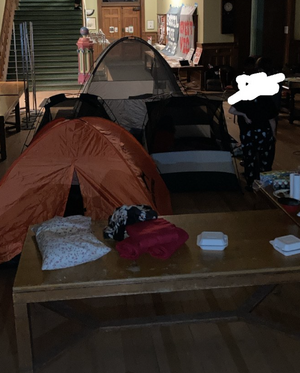
Tents at the Old Vic occupation.

Divestment Announcement
The official press release announcing Vic’s divestment decision made passing reference to students “who have been advocating for this issue for many years,” but did not mention the ongoing encampment and largely focused on the work of the Board of Regents since 2018. [52] An earlier statement by McEwen emphasized the “importance of due diligence and process” and stated that “progress is often not as fast as we would like.” [53] However, the divestment announcement was made during the encampment, less than 3 weeks after it began, which indicates that processes that might not normally be fast can be sped up through disruptive actions. The encampment dispersed after the divestment announcement.
Campaign organizers have different opinions on the direct impact of the occupation:
- One participant believed that divestment would have happened regardless if the BoR’s process had played out. [54]
- Another stated, “I think 95% of the reason why they divested was because of the direct action.” [55]
Campaign participants tend to agree that the occupation threatened Vic’s reputation, accelerating the conditions needed for divestment. The act of taking up space was significant, because events had to be relocated and important meetings were impacted. [56]
- One participant recounted how they “woke up to people walking over my head…someone important, like a donor came, and obviously it’s not a good look if there are a bunch of tents and a bunch of kids sleeping on the floor all around your college.” [57]
- In addition to scrutiny from potential donors, the occupation received media attention.
- All of this was occurring during McEwen’s first year as President, after she had publicly stated her intentions to support divestment. [58]
- The organizers suggested that the occupation left the college with limited options. Their earlier commitments to work with students on the divestment issue prevented them from outright rejecting the demands without further damaging their reputation. They likely had to act a lot faster than they would have preferred to.
Other impacts:
- Increased organizing capacity and knowledge transfer for future student movements.
- The other federated colleges committed to divestment soon after, and Trinity *College has been the first to successfully divest.
- The UofT School of the Environment cut ties with fossil fuel funding. [59]
It is important to keep in mind that the successes of the occupation happened under circumstances that already favoured divestment. Without the UofT divestment precedent and the BoR’s existing work looking into possible divestment, the occupation’s outcome may not have been as productive. Student activists should be aware of the social climate of their institutions and the views/plans of their administrators when planning actions.
Reflections on Strategy
Challenges of the Occupation
- Students camping out experienced burnout and exhaustion. The occupation was near the end of the semester so many students had final assignments and exams approaching.
- People were dissatisfied with the decision making process, which was concentrated within a small group of people.
- These were mainly older students who had already been involved with CJUofT and the Divest Vic campaign, and had made the initial decision to escalate.
- Younger and newer participants were sidelined and not everyone was given access to information because some organizers were concerned about security and leaks.
- One participant believes that while this decision making structure would not have lasted long term, “it worked for the Vic occupation because it was so drastic, and it was by that point the longest encampment in all of Canada.” This type of disruptive action was a new experience for most of the younger students, and “there was just a concentration of knowledge within those [older] people…” who had done organizing in the past and were more familiar with divestment. [60]
- The dissatisfaction and conflict created because of this concern led CJUofT to re-structure the following summer and develop more democratic decision making.
- Access to information and decision making authority sometimes reinforced existing societal power imbalances. This included the sidelining of racialized participants’ perspectives and contributions and the creation of inner circles that excluded students who did not live near the university campus or within downtown Toronto - which often tends to be lower income students commuting from surrounding suburbs. [61]
- A major long term challenge after the occupation ended was holding the college accountable and increasing transparency during the divestment progress, which was one of the initial demands of the campaign.
- One participant believes that this was partially due to people’s grievances during the occupation, which affected the momentum and level of commitment to this particular campaign.
- Most participants began focusing on other campaigns within CJUofT, such as Fossil Free Research or Banks off Campus. [62]
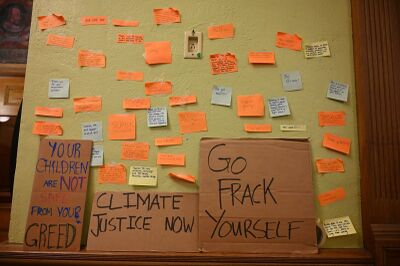
Signs and post-it notes in support of the Old Vic occupation.

The Role of Community Care
Interviews with campaign participants all highlighted the importance of interpersonal and community support during the occupation.
- Students camping out at Old Vic formed strong friendships
- Students worked collaboratively on each others’ assignments to alleviate stress and workload for each individual
- Students with residence meal plans bought food for other occupiers
- Student organizations held events at Old Vic to express support and increase awareness of the cause
- Professors held their classes in Old Vic, which helped the occupation take up more space, further disrupted the college, and likely improved the credibility of the cause
- Professors gave students extensions on assignments, excused absences, and allowed students to use their classes as a platform to promote the occupation
The sense of community and friendship that the occupation fostered was cited as the main way students combatted the burnout and exhaustion that came with camping out. This was a major reason the campaign retained support, even after the occupation ended. This was in spite of general dissatisfaction by most students with the hierarchical structure of the occupation and the centralization of decision making power within a few select individuals.
Knowledge Transfer and Institutional Memory
The Divest Vic campaign faced issues with effective transfer of knowledge from the UofT campaign, according to statements by participants and evidenced by the parallel challenges experienced during both campaigns.
- Knowledge transfer was impacted by the pandemic.
- More generally, maintaining momentum and passing along essential knowledge and skills in student movements is impacted by student turnover.
- To sustain movements, new activists need to be trained and need to be aware of the experiences of their predecessors. Campus organizations need to build institutional memory. [63] One interview participant emphasized that Divest Vic struggled with this and the organization’s ability to record and archive information still needs improvement. [64]
- There has been a great deal of progress made. An important achievement of Divest Vic was its impact on the People’s Circle for Palestine, an encampment occurring during the summer of 2024. Interview participants emphasized how much the experiences of the former helped organize and sustain the latter by:
- Establishing a long standing activist organization on campus that is able to rally students when necessary
- Providing resources, training, and experience to newer activists
- Creating a fairly recent precedent of occupation/escalation tactics at UofT
- Enabling direct consultation/coordination between leaders of Divest Vic with organizers of the encampment
References
- ↑ Olivia Chen, "The Explainer: Federated colleges," The Varsity, September 19, 2016. https://thevarsity.ca/2016/09/19/the-explainer-federated-colleges/
- ↑ Abdul Martin Sarfraz, " ‘We will not leave’: University students dig in heels at fossil fuel divestment protest ," National Observer, April 11, 2023. https://www.nationalobserver.com/2023/04/11/news/we-will-not-leave-university-students-dig-heels-fossil-fuel-divestment-protest
- ↑ Jessie Schwalb, "Victoria University agrees to divest from fossil fuel companies by 2030," The Varsity, April 13, 2023. https://thevarsity.ca/2023/04/13/victoria-university-agrees-to-divest-from-fossil-fuel-companies-by-2030/
- ↑ Amanda Harvey-Sánchez, U of T Fossil Fuel Divestment Timeline, 2022. https://utoronto.scholaris.ca/server/api/core/bitstreams/d57aea4f-3485-4c94-8533-45c2e128b011/content
- ↑ Meric S. Gertler, "Letter to the Community: Divestment, Net Zero and a Climate Positive Campus," Office of the President. https://president.utoronto.ca/letter-to-the-community-divestment-net-zero-and-a-climate-positive-campus/
- ↑ Rhonda McEwen, "Letter to the Community," Victoria College, April 6, 2023. https://vic.utoronto.ca/news/letter-to-the-community
- ↑ "Mary Mounfield," Chancellors' Circle of Benefactors, n.d. https://www.chancellorscircle.utoronto.ca/members/mary-mounfield/
- ↑ It is unclear what exactly led to the decision to divest UofT’s endowment, and people involved with both campaigns attribute the decision to a variety of external factors. However, it is difficult to argue that the efforts of students pushing for divestment for 11 years had no impact; likely, these made divestment a reputation booster for UofT. This interpretation is consistent with the fact that the months preceding divestment had involved several events impacting UofT’s image, which campaign participants suggested were mitigated by the positive press of the divestment announcement.
- ↑ Anonymous interview 2.
- ↑ "Divest Generation Mini Series: Episode 1," 23:00 minutes, Climate Justice Radio. https://climatejusticeto.com/radio/
- ↑ Lang and Harvey-Sánchez, "Divestment and beyond," Briarpatch, May 4, 2022. https://briarpatchmagazine.com/articles/view/divestment-and-beyond
- ↑ Facebook post from UofT 350.org. https://www.facebook.com/share/1AuGwj3SBy/
- ↑ Victoria University Students' Administrative Council Constitution, revised March 2025. https://docs.google.com/document/d/1-R4ZLKRdQ_Q3Z-5x_qU1VkIx5YSkpyz76dyq3-E-Ju0/edit?tab=t.0
- ↑ "Board of Regents," Victoria College. https://vicu.utoronto.ca/about-victoria/board-of-regents
- ↑ Max Lees, "An interview with Vic President Dr. Rhonda McEwen," The Strant, October 11, 2022. https://thestrand.ca/an-interview-with-vic-president-dr-rhonda-mcewen/
- ↑ Climate Justice UofT, All Eyes on Vic: Welcome to the Occupation of Old Vic. https://docs.google.com/document/d/16ynLn3Jp3E2B0wZKJiiO_Zu_RrxE2p5n9FUbz_NPOmw/edit?tab=t.0
- ↑ Climate Justice UofT, Put Climate Justice on the Agenda! Sidewalk Chalk Party, Facebook event, October 11, 2018. https://www.facebook.com/events/2134519083488449
- ↑ Climate Justice UofT, Stick it to the Board of Regents, Facebook event, December 13, 2018. https://www.facebook.com/events/270701486937879
- ↑ Victoria University Students' Administrative Council, Divest Canada Coalition Open Letter, October 2, 2020. https://www.vusac.ca/_files/ugd/7ea68e_75e34c320dda496fb928f2f840a12a51.pdf
- ↑ Mathula Muhundan, "VUSAC Fall 2021 elections results," The Strand, October 13, 2021. https://thestrand.ca/vusac-fall-2021-elections-results/
- ↑ Climate Justice UofT, All Eyes on Vic.
- ↑ Climate Justice UofT, Divest Vic! Petition. https://docs.google.com/forms/d/e/1FAIpQLSfPo_w781_BQmViGYRLIp7gI4V36PmYU_CrSHC-SvKlpSd0xw/viewform
- ↑ Victoria University Students' Administrative Council, "Draft: 030323 Winter Caucus Minutes," March 3, 2023. https://docs.google.com/document/d/12tOBckqXKe5eaK8j344jd1czJhgdhHoMlcqADlVCKBc/edit?tab=t.0
- ↑ Ibid.
- ↑ Sam Rosati Martin, Janna Abbas, and Rion Levy, "Vic's sp(oil)ed reputation," The Strand, January 24, 2023. https://thestrand.ca/vics-spoiled-reputation/
- ↑ Max Lees, "An interview with Vic President."
- ↑ Victoria University Students' Administrative Council, "Draft_ 112522 Fall Caucus Minutes," November 25, 2022. https://docs.google.com/document/d/1WcQvx4K3nAxHbJQP-Tb_z1wxeNaNFit8/edit
- ↑ Climate Justice UofT, All Eyes on Vic.
- ↑ Janna Abbas and Rion Levy, "UofT students begin occupation of Victoria College," The Strand, April 4, 2023. https://thestrand.ca/uoft-students-begin-occupation-of-victoria-college/
- ↑ Anonymous interview 3.
- ↑ Atlas Changulani, "Vic's divestment was a student win, but it wasn't enough," The Strand, August 28, 2023. https://thestrand.ca/vics-divestment-was-a-student-win-but-it-wasnt-enough/
- ↑ Abbas and Levy, "UofT students begin occupation."
- ↑ Ibid.
- ↑ VUSAC, "Draft: 030323 Winter Caucus Minutes."
- ↑ McEwen, "Letter to the Community."
- ↑ Climate Justice UofT Instagram post, April 6, 2023. https://www.instagram.com/p/CqtHDuaOSid/?utm_source=ig_web_copy_link&img_index=2
- ↑ "Victoria University Divests from Direct Fossil Fuel Producers," Victoria College, April 13, 2023. https://vic.utoronto.ca/news/victoria-university-divests-from-direct-fossil-fuel-producers
- ↑ Climate Justice UofT, DIVEST THE FEDERATED COLLEGES. https://docs.google.com/document/d/1-uMH4WN6_695Qp5rraDbC5_KnSDrEexnLdLCNiwg6Pw/edit?tab=t.0
- ↑ Anonymous interviews 1, 2, and 3.
- ↑ Anonymous interview 1.
- ↑ Climate Justice UofT, DIVEST THE FEDERATED COLLEGES.
- ↑ Jessie Schwalb, "Student occupation demanding Victoria University divest from fossil fuels reaches seventh day," April 2, 2023. https://thevarsity.ca/2023/04/02/student-occupation-demanding-victoria-university-divest-from-fossil-fuels-reaches-seventh-day/
- ↑ Anonymous interview 1.
- ↑ "Divest Generation Mini Series: Episode 2," 42:00 minutes, Climate Justice Radio. https://climatejusticeto.com/radio/
- ↑ Lang and Harvey-Sánchez, "Divestment and beyond."
- ↑ Anonymous interview 2.
- ↑ Anonymous interview 2.
- ↑ Climate Justice UofT, All Eyes On Vic.
- ↑ Anonymous interview 3.
- ↑ Anonymous interview 3.
- ↑ Climate Justice UofT, All Eyes on Vic.
- ↑ "Victoria University Divests," Victoria College.
- ↑ McEwen, "Letter to the Community."
- ↑ Anonymous interview 3.
- ↑ Anonymous interview 2.
- ↑ Anonymous interviews 1 and 2.
- ↑ Anonymous interview 1.
- ↑ Lees, "An interview with Vic President."
- ↑ Guidelines on Fossil Fuel Funding, University of Toronto School of the Environment. https://www.environment.utoronto.ca/about-us/our-department/guidelines-fossil-fuel-funding
- ↑ Anonymous interview 2.
- ↑ Anonymous interview 1.
- ↑ Anonymous interview 2.
- ↑ "Navigating turnover in student groups," Climate Justice Organizing HUB Wiki. https://en.wiki.lehub.ca/index.php/Navigating_turnover_in_student_groups
- ↑ Anonymous interview 2.