Myths of the “Energy Transition”: Difference between revisions
No edit summary |
No edit summary |
||
| (13 intermediate revisions by the same user not shown) | |||
| Line 1: | Line 1: | ||
''This article is a translation from the [https://fr.wiki.lehub.ca/index.php/Mythes_sur_la_%C2%AB_transition_%C3%A9nerg%C3%A9tique_%C2%BB original] written by the HUB's Francophone Librarian.'' | |||
<p>People often speak of the “'''energy transition'''” as if it were a plan that could save humanity from the climate crisis. But what is it really? The so-called energy transition pushed for by the state is little more than a project to revitalize the mining industry. Ultimately, as we will explore throughout this text, this project is simply another chapter in the long history of extractivism, colonialism, capitalism, and ecocide.</p> | <p>People often speak of the “'''energy transition'''” as if it were a plan that could save humanity from the climate crisis. But what is it really? The so-called energy transition pushed for by the state is little more than a project to revitalize the mining industry. Ultimately, as we will explore throughout this text, this project is simply another chapter in the long history of extractivism, colonialism, capitalism, and ecocide.</p> | ||
<p>This article offers '''a wide lens on the mining industry''' in the 21st century, on a global scale. It will allow for an understanding of the direct connections between the mining industry and the greenwashing underway in the “energy transition”. We will examine the contradictions inherent in “transition minerals”, and we will explore the links between the mining operations that produce them and the colonial, capitalist system that’s driving the process.</p> | <p>This article offers '''a wide lens on the mining industry''' in the 21st century, on a global scale. It will allow for an understanding of the direct connections between the mining industry and the greenwashing underway in the “energy transition”. We will examine the contradictions inherent in “transition minerals”, and we will explore the links between the mining operations that produce them and the colonial, capitalist system that’s driving the process.</p> | ||
| Line 13: | Line 14: | ||
=== How many mines are there on Earth? === | === How many mines are there on Earth? === | ||
<p>It is difficult to evaluate the number of active mines in existence, as mining corporations use various means to conceal information on their mining operations. However, the most exhaustive database lists 34,820 mines, including those that are no longer active. It’s estimated that more than 100,000 km2 of the planet’s surface is occupied by active mines in 2022, a statistic which excludes the 40% of all mines that are underground.<ref>Celia Izoard | <p>It is difficult to evaluate the number of active mines in existence, as mining corporations use various means to conceal information on their mining operations. However, the most exhaustive database lists 34,820 mines, including those that are no longer active. It’s estimated that more than 100,000 km2 of the planet’s surface is occupied by active mines in 2022, a statistic which excludes the 40% of all mines that are underground. <ref>Celia Izoard, 2024, ''La ruée minière au XXI<sup>e</sup> siècle : Enquête sur les métaux à l'ère de la transition.'' Éditions de la rue Dorion, pp.57-58.</ref> </p> | ||
=== Where are these mines? === | === Where are these mines? === | ||
<p>Contrary to popular belief, mines can be found throughout the world even if the majority are located in the Global South. Mines have colonized every continent and exist in nearly every country—including Colombia, Ukraine, Morocco, the African Great Lakes region, Mexico, Spain, Chile, Canada, Brazil, Portugal, Papua New Guinea, the United States, and Turkey, to name just a few.<ref>''Ibid.'', | <p>Contrary to popular belief, mines can be found throughout the world even if the majority are located in the Global South. Mines have colonized every continent and exist in nearly every country—including Colombia, Ukraine, Morocco, the African Great Lakes region, Mexico, Spain, Chile, Canada, Brazil, Portugal, Papua New Guinea, the United States, and Turkey, to name just a few. <ref>''Ibid.'', pp.107-116.</ref> </p> | ||
=== How many minerals do we produce? === | === How many minerals do we produce? === | ||
<p>With more mines than ever, we are also mining more minerals. Since the turn of the century, we are currently mining double the amount of minerals per year, on a global basis.<ref>''Ibid.'', p.16.</ref> </p> | <p>With more mines than ever, we are also mining more minerals. Since the turn of the century, we are currently mining double the amount of minerals per year, on a global basis. <ref>''Ibid.'', p.16.</ref> </p> | ||
<p>Not only are we extracting more and more minerals, but the pace of this extraction is accelerating. Over the next 20 years, the annual mining of minerals is expected to increase tenfold. If this market trend continues, “In 30 years, we’re set to extract as many minerals as have been extracted since the beginning of human history.”<ref>''Ibid.'', p.33.</ref> </p> | <p>Not only are we extracting more and more minerals, but the pace of this extraction is accelerating. Over the next 20 years, the annual mining of minerals is expected to increase tenfold. If this market trend continues, “In 30 years, we’re set to extract as many minerals as have been extracted since the beginning of human history.” <ref>''Ibid.'', p.33.</ref> </p> | ||
<p>Mining remains a pressing concern—and the stakes are urgent.</p> | <p>Mining remains a pressing concern—and the stakes are urgent.</p> | ||
== There are enough minerals for our current economies to be decarbonized == | == There are enough minerals for our current economies to be decarbonized == | ||
<p><span style="background-color: rgb(209, 241, 238);">''There are not enough minerals available or accessible to decarbonize every country if their economies are maintained at their current scale. In this context, rich countries are competing to decarbonize their economies at the expense of the rest of the world''</span>.</p> | <p><span style="background-color: rgb(209, 241, 238);">''There are not enough minerals available or accessible to decarbonize every country if their economies are maintained at their current scale. In this context, rich countries are competing to decarbonize their economies at the expense of the rest of the world''</span>.</p> | ||
[[File:Screenshot 2025-07-15 161456.png|300px|thumb|Metal in 2022 Global Reserves. Taken from an online talk by Professor Simon Michaux, available here https://www.youtube.com/watch?v=MBVmnKuBocc&t=2614s]] | |||
=== Mineral deposits are increasingly less concentrated === | === Mineral deposits are increasingly less concentrated === | ||
<p>Mineral resources were already in short supply. Until the 19th century, you could find “native” gold or “native” silver, i.e., pure extract. Today, mineral dust is mined in rocks 300 to 3,000 metres below the surface, because metal deposits are increasingly less concentrated: this means that more rocks need to be extracted to obtain the same quantity of metal.<ref>''Ibid.'', p.41.</ref> Extracting additional rock necessarily means more toxic waste and more contaminated water. We also have to dig further, both underground and above ground, to obtain rock with a high enough concentration of minerals. In short, mining is becoming ever more technically complex and ever more polluting.</p> | <p>Mineral resources were already in short supply. Until the 19th century, you could find “native” gold or “native” silver, i.e., pure extract. Today, mineral dust is mined in rocks 300 to 3,000 metres below the surface, because metal deposits are increasingly less concentrated: this means that more rocks need to be extracted to obtain the same quantity of metal. <ref>''Ibid.'', p.41.</ref> Extracting additional rock necessarily means more toxic waste and more contaminated water. We also have to dig further, both underground and above ground, to obtain rock with a high enough concentration of minerals. In short, mining is becoming ever more technically complex and ever more polluting.</p> | ||
=== How many minerals will it take for the “transition”? === | === How many minerals will it take for the “transition”? === | ||
<p>The current mining rush is taking place in the context of mineral resource scarcity. The capitalist elites’ “energy transition” project therefore depends on an immense and growing need for resources, drawn from an ever-dwindling supply. Electrifying Britain’s car stock alone would take two years of the world’s current annual | <p>The current mining rush is taking place in the context of mineral resource scarcity. The capitalist elites’ “energy transition” project therefore depends on an immense and growing need for resources, drawn from an ever-dwindling supply. Electrifying Britain’s car stock alone would take two years of the world’s current annual cobalt production, 75% of its lithium production, and half that of its copper production. <ref>''Ibid.'', pp.28-30</ref> The most exhaustive study to date, carried out by the Geological Institute of Finland, estimates that to decarbonize the planet’s entire energy production, it would be necessary to use 28 times the current annual world production of copper, 74 times that of nickel, more than 1,000 times that of lithium, and so on. <ref>''Ibid.'', p.33</ref> Given that industrial activity and capitalist production on the planet continues to grow, these numbers are likely to increase even further over the next few years.</p> | ||
===States are worried about mineral capacity=== | === States are worried about mineral capacity === | ||
<p>Manufacturers and political elites themselves create alliances between states in order to secure their portion of “transition” minerals: “Western powers have banded together to create an international market for minerals between allied countries — such as the strategic mineral partnership agreement in June 2022 between the United States, the European Commission, Australia, Canada, Finland, France, Germany, Japan, the United Kingdom, Sweden and South Korea”.<ref>''Ibid.'', p.198</ref> More proof that the mineral supply remains uncertain.<p> | <p>Manufacturers and political elites themselves create alliances between states in order to secure their portion of “transition” minerals: “Western powers have banded together to create an international market for minerals between allied countries — such as the strategic mineral partnership agreement in June 2022 between the United States, the European Commission, Australia, Canada, Finland, France, Germany, Japan, the United Kingdom, Sweden and South Korea”. <ref>''Ibid.'', p.198</ref> More proof that the mineral supply remains uncertain.</p> | ||
<p>In summary, '''there are serious reasons to doubt the viability of the capitalist “energy transition” project at the global scale'''. It is extremely likely that the mineral supply will not be sufficient, or that the costs to extract it will push the change beyond the reach of most industries.</p> | <p>In summary, '''there are serious reasons to doubt the viability of the capitalist “energy transition” project at the global scale'''. It is extremely likely that the mineral supply will not be sufficient, or that the costs to extract it will push the change beyond the reach of most industries.</p> | ||
==Mines are needed to extract the minerals needed for the energy transition== | |||
== Mines are needed to extract the minerals needed for the energy transition == | |||
<p>The “energy transition” imposed by capitalist states is little more than a smokescreen. This project, a blatant example of greenwashing, does nothing to protect the environment. Its only aim is to maintain the capitalist mode of production and the enrichment of the dominant classes.</p> | <p>The “energy transition” imposed by capitalist states is little more than a smokescreen. This project, a blatant example of greenwashing, does nothing to protect the environment. Its only aim is to maintain the capitalist mode of production and the enrichment of the dominant classes.</p> | ||
===Minerals critical to the technology sector=== | |||
=== Minerals critical to the technology sector === | |||
Who could have foreseen that the famous “transition minerals” would just happen to be the very same ones that are essential to the technology, weapons, and aerospace industries? Often, when we look at where these minerals go once they have been extracted we find that they are fed into destructive industries that have nothing to do with the “energy transition”. Here are a few examples of where these “versatile” minerals go: | Who could have foreseen that the famous “transition minerals” would just happen to be the very same ones that are essential to the technology, weapons, and aerospace industries? Often, when we look at where these minerals go once they have been extracted we find that they are fed into destructive industries that have nothing to do with the “energy transition”. Here are a few examples of where these “versatile” minerals go: | ||
::''“For example, [colonial governments] have put forward the need to exploit rare earth deposits in order to obtain neodymium for the permanent magnets in wind turbines. But as noted by Judith Pigneur, geologist and doctor of industrial engineering, only a fraction of what is produced is used for this purpose. Although neodymium plays a critical role in the production of electronic boards, speakers and headphones, it is also used in aerospace and weapons manufacture. Lithium, cobalt and graphite are as necessary for the production of electric vehicle batteries as they are for electronic devices. Copper mines are used as much to electrify transport as they are to wire data centres. Silver mines provide contactors for photovoltaic panels, while also furnishing the primary raw materials for any connected smart device.”'' | ::''“For example, [colonial governments] have put forward the need to exploit rare earth deposits in order to obtain neodymium for the permanent magnets in wind turbines. But as noted by Judith Pigneur, geologist and doctor of industrial engineering, only a fraction of what is produced is used for this purpose. Although neodymium plays a critical role in the production of electronic boards, speakers and headphones, it is also used in aerospace and weapons manufacture. Lithium, cobalt and graphite are as necessary for the production of electric vehicle batteries as they are for electronic devices. Copper mines are used as much to electrify transport as they are to wire data centres. Silver mines provide contactors for photovoltaic panels, while also furnishing the primary raw materials for any connected smart device.”'' <ref>''Ibid.'', pp.176-177</ref> | ||
<p>What’s more, the majority of “energy transition” mineral deposits contain large quantities of the minerals critical to the technology sector, as they are often found mixed together. For example, copper mines often serve as sites for the exploitation of palladium, rhodium, ruthenium, iridium, silver, molybdenum, selenium, platinum, and terbium, all minerals that are critical to the production of cellphones. | <p>What’s more, the majority of “energy transition” mineral deposits contain large quantities of the minerals critical to the technology sector, as they are often found mixed together. For example, copper mines often serve as sites for the exploitation of palladium, rhodium, ruthenium, iridium, silver, molybdenum, selenium, platinum, and terbium, all minerals that are critical to the production of cellphones. <ref>''Ibid.'', p. 177.</ref> Mining companies take advantage of the opportunity to claim that they are working towards the “energy transition” when, in reality, they are mining a range of minerals destined for the tech sector.</p> | ||
===Minerals critical to the weapons industry=== | |||
=== Minerals critical to the weapons industry === | |||
In addition to being used to manufacture electronics, “transition minerals” are particularly useful for the weapons industry. It takes an astronomical quantity of minerals to manufacture aircraft and military equipment. Since the First World War and the Cold War, states have embarked on arms races that consume immense amounts of minerals. In addition, military crafts are getting ever larger and require more and more minerals: | In addition to being used to manufacture electronics, “transition minerals” are particularly useful for the weapons industry. It takes an astronomical quantity of minerals to manufacture aircraft and military equipment. Since the First World War and the Cold War, states have embarked on arms races that consume immense amounts of minerals. In addition, military crafts are getting ever larger and require more and more minerals: | ||
::''“To get an idea of the increase in demand for minerals linked to armaments, it is enough to compare the size of tanks: the Renault tank of the First World War had a mass of 6.7 tonnes; the U.S. Army’s M1 Abrams, in use since 1978, weighs 63 tonnes, over ten times more. An MRAP (armoured vehicle resistant to explosive devices) contains between three and four tonnes of steel mixed with nickel, manganese, chromium or molybdenum. In 2007 alone, during the offensive in Iraq, the United States produced one thousand of them.”<ref>''Ibid.'', p.188.</ref> | ::''“To get an idea of the increase in demand for minerals linked to armaments, it is enough to compare the size of tanks: the Renault tank of the First World War had a mass of 6.7 tonnes; the U.S. Army’s M1 Abrams, in use since 1978, weighs 63 tonnes, over ten times more. An MRAP (armoured vehicle resistant to explosive devices) contains between three and four tonnes of steel mixed with nickel, manganese, chromium or molybdenum. In 2007 alone, during the offensive in Iraq, the United States produced one thousand of them.”'' <ref>''Ibid.'', p.188.</ref> | ||
<p>Since the wars in Ukraine and Palestine, western nations have hurried to relaunch their defence industries. The global graphite deposit, a “critical” mineral for both the energy transition and the military industry, is mostly found in China. They are by far the greatest producer of graphite in the world [https://protectionpetitenation.com/concurrence-mondiale-graphite | ::[[File:Screenshot 2025-07-15 153941.png|300px|frameless]] [[File:Screenshot 2025-07-15 154016.png|300px|frameless]] [[File:Screenshot 2025-07-15 155008.png|300px|frameless]] | ||
<p>Since the '''wars in Ukraine and Palestine''', western nations have hurried to relaunch their defence industries. The global graphite deposit, a “critical” mineral for both the energy transition and the military industry, is mostly found in China. They are by far the greatest producer of graphite in the world. <ref>"[https://protectionpetitenation.com/concurrence-mondiale-graphite Concurrence mondiale graphite]," Regroupement de Protection des Lacs de la Petite Nation.</ref> Ukraine, for its part, is ranked fifth in this list, which partially explains the European Union’s readiness to defend it in the face of the Russian invasion. There are strong reasons to believe that the solidarity extended by western powers to Ukraine largely depends on securing access to graphite. <ref>Izoard, ''La ruée minière'', pp. 190-91.</ref> There are numerous Canadian arms manufacturers whose weapons are sent to the Israeli army to carry out the genocide in Palestine. Héroux-Devtek is one such company, whose Longueil factory produces the landing gear used by the F-35 military planes deployed by Israel over Gaza. <ref>Léa Beaulieu-Kratchanov, "[https://pivot.quebec/2024/04/02/heroux-devtek-bloque-pour-sa-contribution-aux-avions-f-35-utilises-a-gaza Héroux-Devtek bloqué pour sa contribution aux avions F-35 utilisées à Gaza]," Pivot, April 2, 2024.</ref> </p> | |||
In so-called Québec, the ''La Loutre mine'' provides a clear example of an instance where military interest in a mining project is on full display. This project, whose mining titles date back to 1988, is now being run by Lomiko Metals Inc., a Canadian mining company based in so-called British Columbia. <ref>"[https://protectionpetitenation.com/historique-du-projet-lomiko/ Historique du Projet Lomiko]," Regroupement de Protection des Lacs de la Petite Nation.</ref> In May 2024, Lomiko received 11 million dollars from the United States Department of Defense to finance their future mine in Haute-Gatineau in the Outaouais region. <ref>Julien Arsenault, [https://www.lapresse.ca/affaires/entreprises/2024-09-26/filiere-quebecoise-des-batteries/la-defense-americaine-sort-encore-le-chequier.php?f Filière québécoise des batteries: La Défense américaine sort encore le chéquier]," La Presse, September 26, 2024</ref> The Pentagon has indicated that the graphite produced by Lomiko will be used to electrify transport infrastructure in North America and for “defence applications”. <ref> Joe Bongiorno, [https://www.lapresse.ca/affaires/2024-07-13/mine-de-graphite/des-villes-de-l-outaouais-s-unissent-pour-faire-des-consultations-sur-un-projet.php?sharing=true Filière québécoise des batteries: La Défense américaine sort encore le chéquier]," La Presse, July 13, 2024.</ref> The people of the region have been organizing for years against this project, which visibly serves to fuel the arms race and the U.S. military. <ref>"[https://miningwatch.ca/news/2024/6/3/energy-transition-or-more-militarism-us-defence-subsidies-graphite-mine-near-montreal Energy transition or more militarism? US defence subsidies for a graphite mine near Montreal provokes anger in civil society]," Mining Watch Canada.</ref> '''Who uses these minerals?''' | |||
Here is a list of currently growing industries that require these minerals: | |||
*Electronics | |||
*Telecommunications | |||
*Information Technology | |||
*Aeronautics | |||
*Automobile | |||
*Aerospace | |||
*Chemistry | |||
*“Green” Energy | |||
*Nuclear | |||
*Weapons Manufacture | |||
*Electrical Infrastructure | |||
<p>In short, when we take a closer look at the interests at play in the exploitation of “transition minerals”, we see that they are pushing the revival of all kinds of destructive industries that largely serve to enrich capitalist elites, such as electronics, weapons and aerospace. The so-called “energy transition“ will therefore be used to design everything but public transport…</p> | |||
==The energy transition is a concrete solution to the climate crisis== | |||
<p>The energy transition as planned by the politico-economic elites is a project that is fundamentally capitalist, colonialist, and destructive to life. As we will see, '''''it is not enough to propose technocratic solutions: we must also fight against the system in place and begin the process of mineral and energy degrowth'''''.</p> | |||
===A profitable opportunity=== | |||
<p>The mining companies will say it themselves - the “energy transition” is a golden opportunity to make more profits:</p> | |||
::''“The global transition to a low-carbon future represents a significant growth opportunity for the Canadian mining industry. Minerals and metals are the cornerstones of low-emission technologies. According to a World Bank report published in 2017, the increased use of such technologies in the wind, solar, and energy storage sectors will increase the demand for many minerals and metals.”'' <ref>Brendan Marshall, ''[https://mining.ca/wp-content/uploads/dlm_uploads/2021/09/Facts-and-Figures-French-Web.pdf Faits et chiffres de l'industrie minière canadienne: 2018]'', L'association minière du Canada, p. 19.</ref> | |||
<p>However, mines will never be ecological, as we can read in the article Myths about “Environmentally responsible mining”.</p> | |||
<p>In short, you don’t have to dig far to find the motivations behind this greenwashing enterprise: the companies themselves admit that it is a pretext to increase mining. Moreover, this increase in mineral production will be used to '''revitalize destructive industries, such as the automotive and tech industries'''. Here are just two examples of capitalist industries that will be favoured by the propaganda of the “energy transition”.</p> | |||
{| class="wikitable" style="border-collapse: collapse; width: 100%; height: 138px;" | |||
|- style="height: 23px;" | |||
| style="width: 50%; height: 23px; background-color: rgb(198, 31, 132);" | <span style="color: rgb(255, 255, 255);" >'''The false hope of the electric car'''</span><br> | |||
| style="width: 50%; height: 23px; background-color: rgb(198, 31, 132);" | <span style="color: rgb(255, 255, 255);" >'''Big tech and the tech sector'''</span><br> | |||
|- style="height: 23px;" | |||
| style="width: 50%; height: 23px;" | | |||
<p>In seemingly every country, politicians are doubling down on electric cars to combat the climate crisis. Yet as we show in our article on the myth that “An electric battery is less polluting than a gas tank”, there is ample proof that electric cars are far from an ecological solution to the problem.</p> | |||
<p>In a political context where the achievement of “carbon targets” is encouraged by international agreements, several countries plan to ban the sale of gasoline-powered vehicles in the coming years. The false hope of the electric car is therefore an opportunity for car companies to pivot and continue to increase their sales. Indeed, the year-to-year number of vehicles on the road is only increasing in so-called Quebec, and sales of electric vehicles are growing faster than those of gasoline-powered cars.<ref>Flavie Villeneuve, "[https://ici.radio-canada.ca/nouvelle/2069993/augmentation-vehicules-routes-quebec-saaq Le parc automobile augmente au Québec, toutes catégories confondues]," Radio-Canada Info, May 3, 2024.</ref> | |||
For their part, Quebec politicians are supporting automotive companies, notably through the Crown corporation Hydro-Québec, which plans to double its electricity production to meet the increasing demand caused by the electrification of the vehicle fleet.<ref>[https://www.hydroquebec.com/a/transition-energetique.html La transition énérgétique et le Plan d'action de Hydro-Québec]," Hydro-Québec.</ref> Its subsidiary [https://lecircuitelectrique.com/fr/ Circuit électrique] is also setting up charging stations throughout the province.</p> | |||
| style="width: 25.5373%; height: 23px;" | | |||
<p>Big Tech and the rest of the tech sector are one of the prime beneficiaries of this new strategy of legitimizing ecocidal capitalism. They consume staggering quantities of so-called “strategic“ minerals.<ref>Izoard, ''La ruée minière'', p.175</ref> The mining rush revived by the “energy transition” therefore favours this industry by ensuring their steady access to the mineral supply.</p> | |||
<p>However, not only is the manufacture of these technological devices harmful in the current capitalist system, but there is no possible world in which it could ever be otherwise. Indeed, even a basic cell phone contains over 50 minerals and connects to destructive industries worldwide, as the processing of even a single mineral often passes through several countries before being completed.</p><ref>Izoard, ''La ruée minière'', pp. 293-5.</ref> | |||
<p>In conclusion, some products are simply not viable, both from an environmental and a social point of view. The same holds true for the products of the military industry, which will only ever be used to destroy lives.</p> | |||
|} | |||
=== The role of the political classes === | |||
<p>The energy transition is, of course, being carried out on behalf of capitalist businesses, but how do the political classes factor into this?</p> | |||
==== Their technocratic allies ==== | |||
<p>Contrary to what they may claim, politicians are not ecological watchdogs: they do not monitor or regulate the economy in a way that protects the environment or counters the climate crisis. Rather, these political elites rely on technocrats to promote technological solutions that would allow us to maintain capitalist growth in a supposedly “sustainable” and “ecological” way. However, as we can see in the myth “New technologies make mines more environmentally responsible”, '''technocratic pseudo-"solutions” make it possible to optimize industrial processes''' in order to produce (and pollute) even more. What’s more, the gadgets invented by these technocrats themselves require significant amounts of resources, which entail the extraction of even more raw materials. <ref>Izoard, ''La ruée minière'', p. 84-5.</ref> </p> | |||
==== The rebound effect ==== | |||
<p>New technologies that are supposedly “environmentally responsible” often cause a “rebound effect”. As explained in the book “For a 99% Ecology: 20 Myths to Debunk About Capitalism”, this phenomenon occurs when greenwashing propaganda relieves people of the guilt of buying a particular good, leading them to consume more of that good or of a similar one. At the societal level, this results in '''an overall increase in the production and consumption of these goods'''. <ref>Frédéric Legault, Arnaud Theurillat-Cloutier et Alain Savard, 2021, ''Pour une écologie du 99% : 20 mythes à déboulonner sur le capitalisme'', Éditions Écosociété, pp. 104-105.</ref> </p> | |||
== We need to propose alternatives and fight the system in place == | |||
<p>The climate crisis cannot be solved by the recycling of minerals or any other technocratic solution envisioned by the promoters of the capitalist “energy transition”.</p> | |||
<p>To avoid the worst of the climate crisis, technological alternatives will certainly be needed to transform our way of life and production. But '''while it is important and rewarding to propose concrete solutions, we must not fall into the trap of abandoning the fight against the system in place''' (which is what the proponents of the energy transition are doing). <ref>Izoard, ''La ruée minière'', pp. 278-80.</ref> Indeed, we would then be playing right into the hands of the political classes: “The capitalist elites have been quick to adopt technical alternatives while ignoring the fundamental political problem that has radically called into question industrial growth.” <ref>''Ibid'', p. 279.</ref> </p> | |||
<p>We need to envision a mineral and energy degrowth '''combined''' with a revolution in the political and economic systems. We need to relearn the crafts that can sustain us and abolish the colonial capitalism that is leading us over a cliff.</p> | |||
= Conclusion = | |||
<p>To summarize, we have seen that:</p> | |||
*The number of mines is increasing and they are found in almost every country in the world. | |||
*There are not enough minerals available on Earth to replace our current use of fossil fuels with renewable energy. | |||
*The “transition mines” produce metals for destructive industries, such as technology, aerospace and weapons manufacture. | |||
*The “energy transition” relies on technical alternatives, while ignoring the root problem of the climate crisis: the capitalist and colonial system. | |||
<p><br></p> | |||
<p style="text-align: center;">''If you would like to submit a correction or additional resources, please write to ayolehub@proton.me.''</p> | |||
Latest revision as of 23:04, 7 October 2025
This article is a translation from the original written by the HUB's Francophone Librarian.
People often speak of the “energy transition” as if it were a plan that could save humanity from the climate crisis. But what is it really? The so-called energy transition pushed for by the state is little more than a project to revitalize the mining industry. Ultimately, as we will explore throughout this text, this project is simply another chapter in the long history of extractivism, colonialism, capitalism, and ecocide.
This article offers a wide lens on the mining industry in the 21st century, on a global scale. It will allow for an understanding of the direct connections between the mining industry and the greenwashing underway in the “energy transition”. We will examine the contradictions inherent in “transition minerals”, and we will explore the links between the mining operations that produce them and the colonial, capitalist system that’s driving the process.
- What is the objective of this article?
This article is one part of a series of articles aimed at dispelling the myths upheld by political and economic elites and mining interests through the project of the “energy transition”. Under the guise of environmentalism, this program is being pushed by governments, lobbyists and the international institutions of neoliberalism. In order to unpack these connections, we will investigate the industrial and logistical stakes at the heart of such an “energy transition”, as well as the real interests at play. By legitimizing the continued existence and growth of the mining sector, these myths are directly in service of capital and the state. It is vital that we deconstruct the myths that threaten both the human population and the whole of the living world. The goal of this series of articles is to offer a counter-discourse to the greenwashing propaganda being pumped out by the forces of colonial capitalism.
- How to navigate this article
The myths that we will explore can be read separately, alone, backwards, upside-down, or in pyjamas. Each section is independent of the others. Feel free to only read about the myths that interest you the most, or enjoy the article in its entirety.
- Where does this information come from?
The majority of the information in this article comes from the book La ruée minière au XXIe siècle : Enquête sur les métaux à l'ère de la transition, written by the investigative journalist Celia Izoard and published by Éditions de la rue Dorion in 2024. This article is a summary of the exhaustive research she undertook and published. At the end of this article, you will find citations for the sections of the book that are cited. Links to other resources used to debunk these myths are also included throughout the text.
The golden age of mining was during the industrial revolution of the 18th and 19th centuries
Mining often feels like a bygone concern, yet this couldn’t be further from reality. Today there are more mines than ever and the mining industry is booming.
How many mines are there on Earth?
It is difficult to evaluate the number of active mines in existence, as mining corporations use various means to conceal information on their mining operations. However, the most exhaustive database lists 34,820 mines, including those that are no longer active. It’s estimated that more than 100,000 km2 of the planet’s surface is occupied by active mines in 2022, a statistic which excludes the 40% of all mines that are underground. [1]
Where are these mines?
Contrary to popular belief, mines can be found throughout the world even if the majority are located in the Global South. Mines have colonized every continent and exist in nearly every country—including Colombia, Ukraine, Morocco, the African Great Lakes region, Mexico, Spain, Chile, Canada, Brazil, Portugal, Papua New Guinea, the United States, and Turkey, to name just a few. [2]
How many minerals do we produce?
With more mines than ever, we are also mining more minerals. Since the turn of the century, we are currently mining double the amount of minerals per year, on a global basis. [3]
Not only are we extracting more and more minerals, but the pace of this extraction is accelerating. Over the next 20 years, the annual mining of minerals is expected to increase tenfold. If this market trend continues, “In 30 years, we’re set to extract as many minerals as have been extracted since the beginning of human history.” [4]
Mining remains a pressing concern—and the stakes are urgent.
There are enough minerals for our current economies to be decarbonized
There are not enough minerals available or accessible to decarbonize every country if their economies are maintained at their current scale. In this context, rich countries are competing to decarbonize their economies at the expense of the rest of the world.

Mineral deposits are increasingly less concentrated
Mineral resources were already in short supply. Until the 19th century, you could find “native” gold or “native” silver, i.e., pure extract. Today, mineral dust is mined in rocks 300 to 3,000 metres below the surface, because metal deposits are increasingly less concentrated: this means that more rocks need to be extracted to obtain the same quantity of metal. [5] Extracting additional rock necessarily means more toxic waste and more contaminated water. We also have to dig further, both underground and above ground, to obtain rock with a high enough concentration of minerals. In short, mining is becoming ever more technically complex and ever more polluting.
How many minerals will it take for the “transition”?
The current mining rush is taking place in the context of mineral resource scarcity. The capitalist elites’ “energy transition” project therefore depends on an immense and growing need for resources, drawn from an ever-dwindling supply. Electrifying Britain’s car stock alone would take two years of the world’s current annual cobalt production, 75% of its lithium production, and half that of its copper production. [6] The most exhaustive study to date, carried out by the Geological Institute of Finland, estimates that to decarbonize the planet’s entire energy production, it would be necessary to use 28 times the current annual world production of copper, 74 times that of nickel, more than 1,000 times that of lithium, and so on. [7] Given that industrial activity and capitalist production on the planet continues to grow, these numbers are likely to increase even further over the next few years.
States are worried about mineral capacity
Manufacturers and political elites themselves create alliances between states in order to secure their portion of “transition” minerals: “Western powers have banded together to create an international market for minerals between allied countries — such as the strategic mineral partnership agreement in June 2022 between the United States, the European Commission, Australia, Canada, Finland, France, Germany, Japan, the United Kingdom, Sweden and South Korea”. [8] More proof that the mineral supply remains uncertain.
In summary, there are serious reasons to doubt the viability of the capitalist “energy transition” project at the global scale. It is extremely likely that the mineral supply will not be sufficient, or that the costs to extract it will push the change beyond the reach of most industries.
Mines are needed to extract the minerals needed for the energy transition
The “energy transition” imposed by capitalist states is little more than a smokescreen. This project, a blatant example of greenwashing, does nothing to protect the environment. Its only aim is to maintain the capitalist mode of production and the enrichment of the dominant classes.
Minerals critical to the technology sector
Who could have foreseen that the famous “transition minerals” would just happen to be the very same ones that are essential to the technology, weapons, and aerospace industries? Often, when we look at where these minerals go once they have been extracted we find that they are fed into destructive industries that have nothing to do with the “energy transition”. Here are a few examples of where these “versatile” minerals go:
- “For example, [colonial governments] have put forward the need to exploit rare earth deposits in order to obtain neodymium for the permanent magnets in wind turbines. But as noted by Judith Pigneur, geologist and doctor of industrial engineering, only a fraction of what is produced is used for this purpose. Although neodymium plays a critical role in the production of electronic boards, speakers and headphones, it is also used in aerospace and weapons manufacture. Lithium, cobalt and graphite are as necessary for the production of electric vehicle batteries as they are for electronic devices. Copper mines are used as much to electrify transport as they are to wire data centres. Silver mines provide contactors for photovoltaic panels, while also furnishing the primary raw materials for any connected smart device.” [9]
What’s more, the majority of “energy transition” mineral deposits contain large quantities of the minerals critical to the technology sector, as they are often found mixed together. For example, copper mines often serve as sites for the exploitation of palladium, rhodium, ruthenium, iridium, silver, molybdenum, selenium, platinum, and terbium, all minerals that are critical to the production of cellphones. [10] Mining companies take advantage of the opportunity to claim that they are working towards the “energy transition” when, in reality, they are mining a range of minerals destined for the tech sector.
Minerals critical to the weapons industry
In addition to being used to manufacture electronics, “transition minerals” are particularly useful for the weapons industry. It takes an astronomical quantity of minerals to manufacture aircraft and military equipment. Since the First World War and the Cold War, states have embarked on arms races that consume immense amounts of minerals. In addition, military crafts are getting ever larger and require more and more minerals:
- “To get an idea of the increase in demand for minerals linked to armaments, it is enough to compare the size of tanks: the Renault tank of the First World War had a mass of 6.7 tonnes; the U.S. Army’s M1 Abrams, in use since 1978, weighs 63 tonnes, over ten times more. An MRAP (armoured vehicle resistant to explosive devices) contains between three and four tonnes of steel mixed with nickel, manganese, chromium or molybdenum. In 2007 alone, during the offensive in Iraq, the United States produced one thousand of them.” [11]
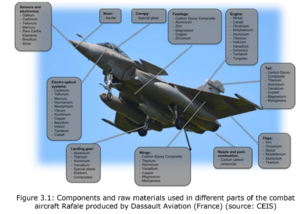
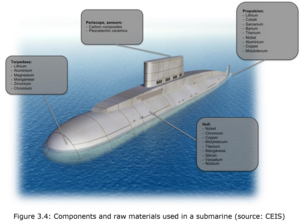
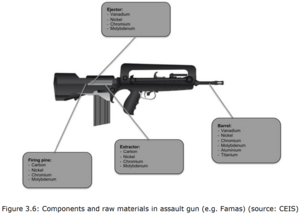


Since the wars in Ukraine and Palestine, western nations have hurried to relaunch their defence industries. The global graphite deposit, a “critical” mineral for both the energy transition and the military industry, is mostly found in China. They are by far the greatest producer of graphite in the world. [12] Ukraine, for its part, is ranked fifth in this list, which partially explains the European Union’s readiness to defend it in the face of the Russian invasion. There are strong reasons to believe that the solidarity extended by western powers to Ukraine largely depends on securing access to graphite. [13] There are numerous Canadian arms manufacturers whose weapons are sent to the Israeli army to carry out the genocide in Palestine. Héroux-Devtek is one such company, whose Longueil factory produces the landing gear used by the F-35 military planes deployed by Israel over Gaza. [14]
In so-called Québec, the La Loutre mine provides a clear example of an instance where military interest in a mining project is on full display. This project, whose mining titles date back to 1988, is now being run by Lomiko Metals Inc., a Canadian mining company based in so-called British Columbia. [15] In May 2024, Lomiko received 11 million dollars from the United States Department of Defense to finance their future mine in Haute-Gatineau in the Outaouais region. [16] The Pentagon has indicated that the graphite produced by Lomiko will be used to electrify transport infrastructure in North America and for “defence applications”. [17] The people of the region have been organizing for years against this project, which visibly serves to fuel the arms race and the U.S. military. [18] Who uses these minerals? Here is a list of currently growing industries that require these minerals:
- Electronics
- Telecommunications
- Information Technology
- Aeronautics
- Automobile
- Aerospace
- Chemistry
- “Green” Energy
- Nuclear
- Weapons Manufacture
- Electrical Infrastructure
In short, when we take a closer look at the interests at play in the exploitation of “transition minerals”, we see that they are pushing the revival of all kinds of destructive industries that largely serve to enrich capitalist elites, such as electronics, weapons and aerospace. The so-called “energy transition“ will therefore be used to design everything but public transport…
The energy transition is a concrete solution to the climate crisis
The energy transition as planned by the politico-economic elites is a project that is fundamentally capitalist, colonialist, and destructive to life. As we will see, it is not enough to propose technocratic solutions: we must also fight against the system in place and begin the process of mineral and energy degrowth.
A profitable opportunity
The mining companies will say it themselves - the “energy transition” is a golden opportunity to make more profits:
- “The global transition to a low-carbon future represents a significant growth opportunity for the Canadian mining industry. Minerals and metals are the cornerstones of low-emission technologies. According to a World Bank report published in 2017, the increased use of such technologies in the wind, solar, and energy storage sectors will increase the demand for many minerals and metals.” [19]
However, mines will never be ecological, as we can read in the article Myths about “Environmentally responsible mining”.
In short, you don’t have to dig far to find the motivations behind this greenwashing enterprise: the companies themselves admit that it is a pretext to increase mining. Moreover, this increase in mineral production will be used to revitalize destructive industries, such as the automotive and tech industries. Here are just two examples of capitalist industries that will be favoured by the propaganda of the “energy transition”.
| The false hope of the electric car |
Big tech and the tech sector |
|
In seemingly every country, politicians are doubling down on electric cars to combat the climate crisis. Yet as we show in our article on the myth that “An electric battery is less polluting than a gas tank”, there is ample proof that electric cars are far from an ecological solution to the problem. In a political context where the achievement of “carbon targets” is encouraged by international agreements, several countries plan to ban the sale of gasoline-powered vehicles in the coming years. The false hope of the electric car is therefore an opportunity for car companies to pivot and continue to increase their sales. Indeed, the year-to-year number of vehicles on the road is only increasing in so-called Quebec, and sales of electric vehicles are growing faster than those of gasoline-powered cars.[20] For their part, Quebec politicians are supporting automotive companies, notably through the Crown corporation Hydro-Québec, which plans to double its electricity production to meet the increasing demand caused by the electrification of the vehicle fleet.[21] Its subsidiary Circuit électrique is also setting up charging stations throughout the province. |
Big Tech and the rest of the tech sector are one of the prime beneficiaries of this new strategy of legitimizing ecocidal capitalism. They consume staggering quantities of so-called “strategic“ minerals.[22] The mining rush revived by the “energy transition” therefore favours this industry by ensuring their steady access to the mineral supply. However, not only is the manufacture of these technological devices harmful in the current capitalist system, but there is no possible world in which it could ever be otherwise. Indeed, even a basic cell phone contains over 50 minerals and connects to destructive industries worldwide, as the processing of even a single mineral often passes through several countries before being completed. [23]In conclusion, some products are simply not viable, both from an environmental and a social point of view. The same holds true for the products of the military industry, which will only ever be used to destroy lives. |
The role of the political classes
The energy transition is, of course, being carried out on behalf of capitalist businesses, but how do the political classes factor into this?
Their technocratic allies
Contrary to what they may claim, politicians are not ecological watchdogs: they do not monitor or regulate the economy in a way that protects the environment or counters the climate crisis. Rather, these political elites rely on technocrats to promote technological solutions that would allow us to maintain capitalist growth in a supposedly “sustainable” and “ecological” way. However, as we can see in the myth “New technologies make mines more environmentally responsible”, technocratic pseudo-"solutions” make it possible to optimize industrial processes in order to produce (and pollute) even more. What’s more, the gadgets invented by these technocrats themselves require significant amounts of resources, which entail the extraction of even more raw materials. [24]
The rebound effect
New technologies that are supposedly “environmentally responsible” often cause a “rebound effect”. As explained in the book “For a 99% Ecology: 20 Myths to Debunk About Capitalism”, this phenomenon occurs when greenwashing propaganda relieves people of the guilt of buying a particular good, leading them to consume more of that good or of a similar one. At the societal level, this results in an overall increase in the production and consumption of these goods. [25]
We need to propose alternatives and fight the system in place
The climate crisis cannot be solved by the recycling of minerals or any other technocratic solution envisioned by the promoters of the capitalist “energy transition”.
To avoid the worst of the climate crisis, technological alternatives will certainly be needed to transform our way of life and production. But while it is important and rewarding to propose concrete solutions, we must not fall into the trap of abandoning the fight against the system in place (which is what the proponents of the energy transition are doing). [26] Indeed, we would then be playing right into the hands of the political classes: “The capitalist elites have been quick to adopt technical alternatives while ignoring the fundamental political problem that has radically called into question industrial growth.” [27]
We need to envision a mineral and energy degrowth combined with a revolution in the political and economic systems. We need to relearn the crafts that can sustain us and abolish the colonial capitalism that is leading us over a cliff.
Conclusion
To summarize, we have seen that:
- The number of mines is increasing and they are found in almost every country in the world.
- There are not enough minerals available on Earth to replace our current use of fossil fuels with renewable energy.
- The “transition mines” produce metals for destructive industries, such as technology, aerospace and weapons manufacture.
- The “energy transition” relies on technical alternatives, while ignoring the root problem of the climate crisis: the capitalist and colonial system.
If you would like to submit a correction or additional resources, please write to ayolehub@proton.me.
- ↑ Celia Izoard, 2024, La ruée minière au XXIe siècle : Enquête sur les métaux à l'ère de la transition. Éditions de la rue Dorion, pp.57-58.
- ↑ Ibid., pp.107-116.
- ↑ Ibid., p.16.
- ↑ Ibid., p.33.
- ↑ Ibid., p.41.
- ↑ Ibid., pp.28-30
- ↑ Ibid., p.33
- ↑ Ibid., p.198
- ↑ Ibid., pp.176-177
- ↑ Ibid., p. 177.
- ↑ Ibid., p.188.
- ↑ "Concurrence mondiale graphite," Regroupement de Protection des Lacs de la Petite Nation.
- ↑ Izoard, La ruée minière, pp. 190-91.
- ↑ Léa Beaulieu-Kratchanov, "Héroux-Devtek bloqué pour sa contribution aux avions F-35 utilisées à Gaza," Pivot, April 2, 2024.
- ↑ "Historique du Projet Lomiko," Regroupement de Protection des Lacs de la Petite Nation.
- ↑ Julien Arsenault, Filière québécoise des batteries: La Défense américaine sort encore le chéquier," La Presse, September 26, 2024
- ↑ Joe Bongiorno, Filière québécoise des batteries: La Défense américaine sort encore le chéquier," La Presse, July 13, 2024.
- ↑ "Energy transition or more militarism? US defence subsidies for a graphite mine near Montreal provokes anger in civil society," Mining Watch Canada.
- ↑ Brendan Marshall, Faits et chiffres de l'industrie minière canadienne: 2018, L'association minière du Canada, p. 19.
- ↑ Flavie Villeneuve, "Le parc automobile augmente au Québec, toutes catégories confondues," Radio-Canada Info, May 3, 2024.
- ↑ La transition énérgétique et le Plan d'action de Hydro-Québec," Hydro-Québec.
- ↑ Izoard, La ruée minière, p.175
- ↑ Izoard, La ruée minière, pp. 293-5.
- ↑ Izoard, La ruée minière, p. 84-5.
- ↑ Frédéric Legault, Arnaud Theurillat-Cloutier et Alain Savard, 2021, Pour une écologie du 99% : 20 mythes à déboulonner sur le capitalisme, Éditions Écosociété, pp. 104-105.
- ↑ Izoard, La ruée minière, pp. 278-80.
- ↑ Ibid, p. 279.